
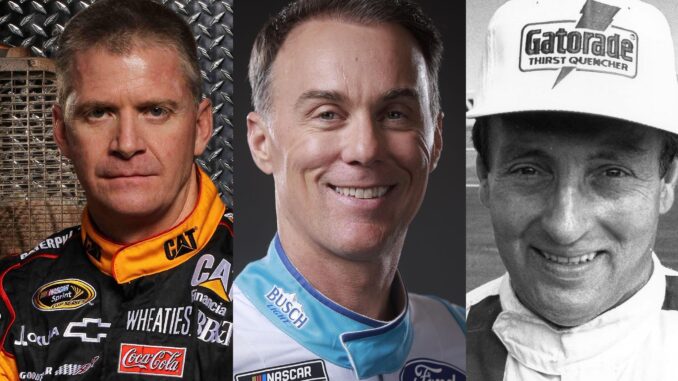
The NASCAR Hall of Fame announced its Class of 2027 on Tuesday, and frankly, it’s a group that feels less like a debate and more like NASCAR finally putting the family silver back where it belongs.
Leading the class is Kevin Harvick, the man who arrived in NASCAR’s darkest hour and somehow turned pressure that would crush most humans into a Hall of Fame career. Joining him are Jeff Burton, NASCAR’s unofficial mayor and occasional voice of reason, and short-track legend Larry Phillips, whose win total exists somewhere between “a lot” and “we stopped counting sometime during the Reagan administration.”
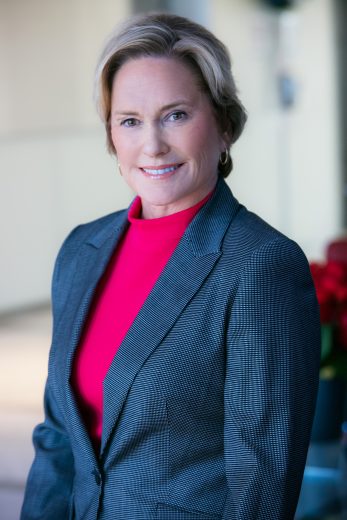
Meanwhile, Lesa France Kennedy was named the recipient of the Landmark Award for Outstanding Contributions to NASCAR, recognizing one of the sport’s most influential architects behind the scenes.
The voting took place Tuesday during a closed-door session at the Charlotte Convention Center, where the NASCAR Hall of Fame Voting Panel sifted through 15 nominees and, one imagines, at least a few arguments fueled by coffee and decades of racing grudges.
Harvick was the runaway selection, collecting 92 percent of the Modern Era ballot. Which is about as close to a unanimous “well, obviously” as you’ll get in NASCAR.
And really, what more is there to say about Harvick?
In 2001, he was handed one of the most impossible jobs in sports: replacing Dale Earnhardt after Earnhardt’s death at Daytona. Most drivers would have spent years drowning under that shadow. Harvick won in just his third Cup start at Atlanta, in one of the sport’s most emotional finishes, then spent the next two decades becoming one of NASCAR’s most relentless competitors.
“The Closer” piled up 60 Cup Series wins, a Daytona 500 victory in 2007, and a championship in 2014 by mastering NASCAR’s then-new elimination playoff system like a man diffusing a bomb while everyone else was still looking for the instruction manual. Since retiring, he’s moved into the FOX Sports booth, where he’s continued doing what Harvick has always done best: saying exactly what he thinks.
Burton’s Hall of Fame path came with less drama but no less importance.
Nicknamed “The Mayor,” Burton built a reputation as one of NASCAR’s smartest and most respected voices, especially when it came to competition and safety. But before the polished TV analyst role at NBC Sports, Burton was busy winning races. A lot of them.
The 1994 Rookie of the Year earned 21 Cup victories, including the first Cup race ever held at Texas Motor Speedway in 1997. His best season came in 1999, when he won six races including the Coca-Cola 600 and Southern 500. Burton also added 27 wins in what is now the NASCAR Xfinity Series, making him one of only 10 drivers with at least 20 victories in both divisions.
Then there’s Larry Phillips, who may be the most wonderfully old-school member of this class.
Trying to pin down exactly how many races Phillips won is a bit like trying to calculate how many beers were consumed in the Talladega infield during the 1980s. Estimates range from 1,000 to 2,000 victories, depending on who’s telling the story and how long they’ve been sitting around the garage bench.
What is known is this: if Phillips rolled his No. 75 through the pit gate, most competitors figured they were racing for second place.
The Springfield, Missouri native dominated short tracks across dirt and asphalt, winning five NASCAR Weekly Series national championships and 220 NASCAR-sanctioned races during an astonishing 11-year stretch from 1989 through 1999. He also captured 13 track championships across three states because apparently sleeping was optional.
As for Kennedy, her impact on NASCAR has been impossible to miss. During more than three decades with International Speedway Corporation and NASCAR, she helped oversee transformative projects including Daytona Rising at Daytona International Speedway, the modernization of Phoenix Raceway, and the development of Kansas Speedway.
The Class of 2027 will officially be inducted Jan. 22, 2027, at the NASCAR Hall of Fame in Charlotte. And honestly, it’s the kind of class that reminds you the sport’s history isn’t just built on championships and trophies. Sometimes it’s built on survival, stubbornness, short tracks, and the occasional refusal to lift off the throttle.

Greg was a writer for DriveTribe supporting Amazon's The Grand Tour and has been published in major publications across the country including the Los Angeles Times, the Cleveland Plain Dealer and the Atlanta Journal-Constitution. He was also a contributor to Chicken Soup for the NASCAR Soul, published in 2010, and the Christmas edition in 2016. He wrote as the NASCAR, Formula 1, Auto Reviews and National Veterans Affairs Examiner for Examiner.com and has appeared on Fox News. He holds a BS degree in communications, and a Masters degree in psychology. He is currently the weekend Motorsports Editor for Autoweek and a regular contributor to Forbes.
- Kyle Busch’s legacy gets a smoky exclamation point in Charlotte - October 10, 2026
- Photos: Kyle Busch Celebration of Life at Charlotte Motor Speedway Friday Oct. 9, 2026 - October 10, 2026
- Layne Riggs gives Honeycutt a Charlotte-sized championship headache - October 9, 2026