
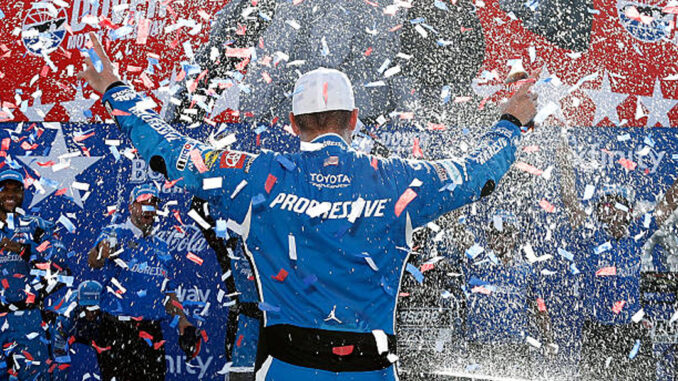
Denny Hamlin started NASCAR’s All-Star Weekend at Dover Motor Speedway with a spin and ended it with another one Sunday. Unlike his qualifying spin Saturday, the one that somehow still ended with him on the pole, this one came with smoke pouring from the rear tires, the crowd on its feet, and a million-dollar grin stretched across his face.
Sunday’s spin was celebratory. The kind you do when you’ve just bullied the field for 200 laps and cashed a check big enough to make even a NASCAR driver blink twice before depositing it.
Hamlin won NASCAR’s All-Star Race by leading 103 of the final 200 laps and holding off his Joe Gibbs Racing teammate Chase Briscoe by .887 seconds.
You can talk about the stories deeper in the field if you want. You can discuss strategy, heartbreak, damaged fenders and bruised egos. But this is the All-Star Race, the one weekend each year where points are thrown in the trash like a gas-station hot dog wrapper. Nobody leaves with a playoff advantage. There is only pride, bent sheet metal, and dollar signs.
And Hamlin left with the biggest pile of those dollar signs.
“Honestly, it makes it a lot easier when you’ve got a car this fast,” Hamlin said afterward. “Hats off to this whole Progressive team.”
What should have been NASCAR’s All-Star cotillion quickly turned into a mosh pit of mayhem with sponsor decals.
The opening 75-lap segment started with a nine-car crash and, in a bit of symmetry only motorsports can provide, ended with another nine-car crash. By the time the smoke cleared from the first stage, 17 of the 36 starters had been involved in accidents. Dover had become less a racetrack and more a very expensive recycling program.
The chaos started almost immediately.
On Lap 2, Ryan Preece found himself squeezed three-wide entering Turn 1 alongside Todd Gilliland and Kyle Larson. There was contact, everyone suddenly discovered there was no more racetrack left, and physics arrived swinging a large hammer. NASCAR threw the red flag while crews surveyed the automotive battlefield.
Things settled briefly before the race remembered what it was supposed to be.
On Lap 63, Carson Hocevar lost a tire and slammed the wall, wiping out what had been a five-second lead for Hamlin. The caution triggered a mix of pit strategies that looked clever for approximately four minutes.
Then came another pileup.
Just after the restart on Lap 73, Zane Smith and Riley Herbst made contact, setting off a chain reaction that collected seven more drivers, including Kyle Busch, Christopher Bell, Chase Elliott and John Hunter Nemechek. Several of them had already survived the opening wreck, only to discover the racing gods had not finished with them yet.
The format treated each segment like a separate race, which only added to the madness. Leaders changed hands between Brad Keselowski, Hamlin, and Bubba Wallace before Wallace inherited the segment win under caution.
By the start of Segment 2, the lineup resembled a survival contest. Cars were patched together in the garage with the urgency of a NASCAR version of “Apollo 13.” Drivers who had crashed earlier suddenly reappeared looking like racing zombies stitched back together with rivets and optimism.
Only 26 cars remained for the second segment, and even that number proved optimistic.
Six laps in, Ross Chastain got loose exiting Turn 2, slapped the outside wall, then spun back across traffic collecting Keselowski and Wallace. Somewhere in the Dover garage, crew chiefs likely began questioning their career choices.
Meanwhile Hamlin, who started 24th for the segment inversion, methodically carved through the field like a man late for dinner.
“I liked it,” Hamlin said of the chaotic format. “It challenged us to have to go through traffic. Otherwise you could just go out there and lead a bunch of laps. Obviously it caused some chaos there and took out some good cars. Overall this is a typical All-Star Race.”
That may have been the understatement of the weekend.
A spin by Ty Gibbs on Lap 50 reset the field again. AJ Allmendinger and Erik Jones stayed out on old tires, effectively volunteering to stand in front of a stampede wearing flip-flops. Allmendinger fought valiantly before finally surrendering the lead to Briscoe on Lap 58.
By the end of the segment, Tyler Reddick had claimed the segment win while Hamlin climbed to third behind Briscoe.
Then came the final 200-lap segment, the part where the patched-up survivors and the genuinely fast cars finally collided into one giant, glorious mess.
Hamlin somehow emerged from the statistical sorcery of the segment averages as the leader for the finale. Among those still alive were Larson and Ryan Blaney, both of whom had spent parts of the evening watching from the infield while crews rebuilt their cars. Blaney even doing so from a photographer’s stand in Turn 1.
Briscoe grabbed the lead at the start of the final segment before Reddick took over on Lap 40. Hamlin lurked behind them, waiting.
Then the planned All-Star caution that flew on Lap 77.
Hamlin won the race off pit road, reclaimed the lead, and from there the race slowly transformed from demolition derby into a heavyweight fight between teammates.
A spin by Joey Logano on Lap 140 produced the final caution and one last restart. Briscoe briefly stole the lead, but Hamlin quickly snatched it back with 30 laps remaining.
For a moment it appeared the finish would become a three-car slugfest involving Hamlin, Briscoe and Reddick. Then Reddick’s Toyota slowed dramatically on Lap 168 with a broken power steering belt, sending him to the garage and leaving the two Joe Gibbs Racing teammates alone to decide the million-dollar prize.
Briscoe kept Hamlin honest but never quite had enough.
“Wish I had a little more rear grip,” Briscoe said. “Anytime I got the lead, I would be so loose it made me vulnerable. When I would get passed, I would come on again.”
Considering Briscoe admitted he’d spent the previous few days battling a stomach bug while his team rebuilt the car after practice damage, second place probably felt equal parts frustrating and miraculous.
“I wish it was a points race because we definitely need the points,” Briscoe joked.
But points were never the point Sunday.
This was the All-Star Race. A strange annual carnival where survival matters almost as much as speed, where racecars leave looking like they’d spent an evening inside a clothes dryer full of bricks, and where one driver leaves with a giant check while everyone else leaves wondering what exactly just happened.
Next Sunday NASCAR returns to seriousness with the Coca-Cola 600 at Charlotte Motor Speedway. The points will matter again. Strategy will matter again. Every finishing position will matter again.
And NASCAR, at least briefly, will stop behaving like a shopping cart with fireworks strapped to it.
RACE RESULTS

Greg was a writer for DriveTribe supporting Amazon's The Grand Tour and has been published in major publications across the country including the Los Angeles Times, the Cleveland Plain Dealer and the Atlanta Journal-Constitution. He was also a contributor to Chicken Soup for the NASCAR Soul, published in 2010, and the Christmas edition in 2016. He wrote as the NASCAR, Formula 1, Auto Reviews and National Veterans Affairs Examiner for Examiner.com and has appeared on Fox News. He holds a BS degree in communications, and a Masters degree in psychology. He is currently the weekend Motorsports Editor for Autoweek and a regular contributor to Forbes.
- Corey Day is making a habit of ruining everyone else’s day - October 11, 2026
- Denny Hamlin salvaged his Sunday, but Larson stole the silverware - October 11, 2026
- Chase Briscoe tells the Chase field to shut up and listen - October 11, 2026