
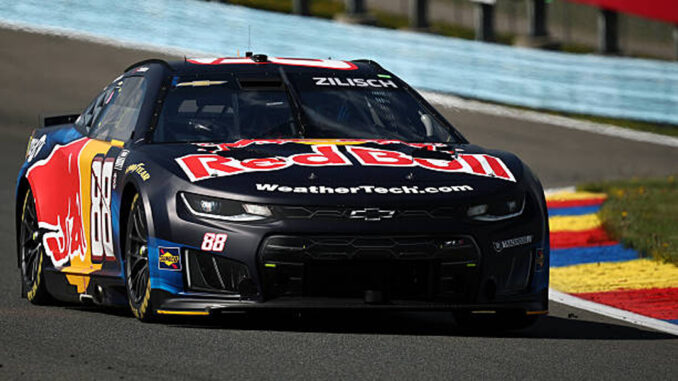
Connor Zilisch spent Sunday at Watkins Glen doing what 19-year-olds are generally not supposed to do in the NASCAR Cup Series. He hounded veterans, diced with Ty Gibbs for the lead, and looked entirely comfortable at the front of the field like some sort of caffeinated road-course assassin.
And then, because motorsports occasionally enjoys behaving like a raccoon trapped in a trash can, the right-front tire on his No. 88 Chevrolet exploded with just a handful of laps remaining.
One minute Zilisch looked poised to pull off the sort of weekend double that would have sent the NASCAR internet into complete emotional collapse. The next, he was limping to pit road while his Trackhouse Racing teammate Shane van Gisbergen disappeared into the distance on the way to victory.
Instead of a trophy, Zilisch got a 20th-place finish and the consolation prize of fastest lap honors.
Which, admittedly, feels a bit like being handed a free appetizer after your house burns down.
Still, the result sheet lies harder than a politician in campaign season. Zilisch was legitimately good Sunday. Very good, in fact. He finished eighth in Stage 2, stayed in the fight all afternoon, and spent the closing laps glued to the rear bumper of Ty Gibbs while trying to pry the lead away.
Afterward, Zilisch sounded more frustrated than defeated.
“It’s just a bummer,” he said. “I feel like I did almost everything right today that I could, but it just goes like that sometimes.”
He admitted van Gisbergen probably had the field covered anyway, which is the racing equivalent of admitting you lost a fistfight to a grizzly bear. There’s no shame in it because everyone else would have lost too.
“I should have passed Ty,” Zilisch added. “I don’t think it would have been any better to stay behind him. I could have saved more fuel in front of him and ran faster, but I’ll learn from it and be better moving forward.”
That last part matters. Because if there’s one thing Justin Marks made crystal clear afterward, it’s that nobody inside Trackhouse sees this as a disaster. Quite the opposite.
Marks immediately went to find his young driver after the race, wrapping an arm around him and reminding him that one shredded tire doesn’t erase a day where he looked like he belonged at the front of a Cup race.
“He did a fantastic job,” Marks said. “He carried that car really well today.”
Then Marks delivered what may quietly be the most important philosophy inside Trackhouse Racing right now: stop treating good runs like rare sightings of Halley’s Comet.
“I don’t want us to view this as one opportunity that we get every once in a while for us to do well,” Marks explained. “My goal is for us to start every Sunday the way we started this Sunday.”
That’s a remarkably healthy approach in modern NASCAR, where young drivers are often judged with the patience and emotional restraint of a man trying to assemble IKEA furniture after three bourbons.
Marks believes what separates the truly elite prospects from the endless line of talented youngsters isn’t raw speed. It’s adaptability. How quickly they absorb information, adjust, and recover when racing punches them directly in the face.
And Watkins Glen did exactly that to Zilisch.
Yet despite the tire failure, the mistakes, and the frustration, Marks sees a driver rapidly figuring it all out.
“We keep digging,” Marks said. “It’s 1/38th of the season.”
Which is true.
But if Zilisch keeps driving like this, the rest of the garage may soon discover that Watkins Glen wasn’t a missed opportunity.
It was a warning shot.

Greg was a writer for DriveTribe supporting Amazon's The Grand Tour and has been published in major publications across the country including the Los Angeles Times, the Cleveland Plain Dealer and the Atlanta Journal-Constitution. He was also a contributor to Chicken Soup for the NASCAR Soul, published in 2010, and the Christmas edition in 2016. He wrote as the NASCAR, Formula 1, Auto Reviews and National Veterans Affairs Examiner for Examiner.com and has appeared on Fox News. He holds a BS degree in communications, and a Masters degree in psychology. He is currently the weekend Motorsports Editor for Autoweek and a regular contributor to Forbes.
- NASCAR’s old Chase format is making the championship fun again - October 19, 2026
- Denny Hamlin’s Phoenix escape plan gets a speeding ticket - October 18, 2026
- Kyle Larson’s tire wasn’t the only thing to go flat at Phoenix - October 18, 2026