
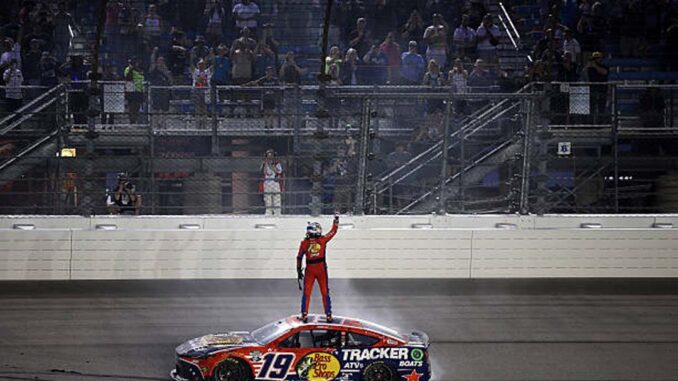
If there is a more American sight than a kid from rural Indiana driving a Bass Pro Shops stock car covered in stars and stripes to Victory Lane on Fourth of July weekend, it’s only because somebody forgot to invite bald eagles and fireworks to the party.
Chase Briscoe didn’t just win Sunday’s eero 400 at Chicagoland Speedway. He practically wrapped himself in the flag while doing it.
Driving the No. 19 Toyota for Joe Gibbs Racing, Briscoe survived 267 laps of crashes, retaliation, questionable strategy, oil on the racetrack, soggy grass, and enough pit-stop gambling to make a Las Vegas blackjack dealer nervous before beating teammate Christopher Bell by 0.276 seconds for his first victory of the season.
The funny part?
For most of the afternoon, it looked like somebody else was going to win.
William Byron controlled long stretches of the race. Denny Hamlin looked like the man to beat early. Bubba Wallace even enjoyed his moment at the front. Kyle Larson led laps before discovering that Chicagoland’s infield had all the traction of a buttered Slip ‘N Slide after days of rain.
Meanwhile, Briscoe just kept hanging around.
“I feel so American winning in the Bass Pro Shops red, white and blue car on Fourth of July weekend, 250 years,” Briscoe said afterward. “Just what an unbelievable race car. James did a great job. The team did a great job. Honestly, I did not see this coming.”
Neither did anyone else.
The race wasted absolutely no time becoming a demolition derby.
Before the field even completed the opening lap, John Hunter Nemechek squeezed Ricky Stenhouse Jr. into the outside wall. Ryan Preece checked up, Erik Jones couldn’t, and Connor Zilisch wound up hammered into the inside wall hard enough to end his afternoon before it had really started. It marked the rookie’s fifth DNF in his last seven Cup starts, a statistic that reads more like a cry for help than a racing record.
Then came the tempers.
Carson Hocevar and Zane Smith traded paint while arguing over a position barely worth fighting about. A few laps later Shane van Gisbergen helped Austin Hill discover that race cars travel backward almost as quickly as they travel forward, sending the Richard Childress Racing driver spinning into the outside wall. The RCR camp immediately suspected the score had just been settled for the San Diego incident.
The first caution turned pit road into an identity crisis.
Seven cars stayed out.
Others took two tires.
Others grabbed four.
Some only wanted fuel.
Crew chiefs looked less like engineers and more like contestants trying to solve a game show puzzle before the buzzer sounded.
William Byron eventually sorted through the madness to win Stage 1 while Hamlin recovered from restarting 21st after taking four tires.
Just when everyone settled in, NASCAR had to slow the race again to repair damaged asphalt on pit road.
Because why not?
Then Larson found the grass.
Exiting Turn 4 on Lap 94, Larson spun into the soaked infield and immediately discovered Mother Nature had turned Chicagoland into a marsh. The No. 5 Chevrolet buried itself deep enough to require a tow truck before Larson limped back to pit road on four shredded tires, two laps down and with any realistic shot at victory buried somewhere under Illinois mud.
The race finally settled into a rhythm until Tyler Reddick’s Toyota decided it hadn’t contributed enough.
Just as green-flag pit stops began, the oil cooler failed, painting both the racetrack and pit road with enough lubricant to keep a tractor running until Christmas. Another caution erased everyone’s strategy and sent cleanup crews scrambling.
Byron regrouped to sweep the first two stages, but there was one problem.
Behind him sat all four Joe Gibbs Racing Toyotas.
Like sharks.
Waiting.
Crew chief James Small finally blinked first.
He called Briscoe to pit road one lap before Byron during the final green-flag cycle. The No. 19 crew responded with its fastest stop of the season, and just like that the race flipped upside down.
Suddenly Briscoe was leading.
Suddenly Byron was chasing.
And suddenly Christopher Bell had become the fastest thing on four wheels.
“I just need to replay that last run,” Bell said. “They made a great adjustment and got the car driving great.”
Bell erased chunk after chunk of Briscoe’s lead until lap traffic entered the picture at exactly the right time for the race leader.
“I kind of got lucky having lap cars,” Briscoe admitted. “I was struggling pretty bad. Christopher was certainly coming. Out of all the people to race against, I knew Christopher was going to be clean with me.”
Bell could only laugh afterward.
“It seems like a monkey can drive these Toyotas,” he joked. “It’s just disappointing when you get beat by another monkey.”
Then he twisted the knife himself.
“I’m just a second-place driver. That’s what I am.”
Hamlin’s hopes disappeared when he brushed the outside wall trying to wring every last ounce out of his Toyota.
“I thought I was in control early on,” Hamlin said. “Briscoe and Bell got their cars really good the second half of the race. I pushed it too far into the wall there with a few laps to go and had to settle for third.”
As for Briscoe, his reward wasn’t just a trophy.
Sunday also happened to be crew chief James Small’s birthday.
“He told me if I won today I could get some chocolate,” Briscoe said with a grin.
Turns out that’s a pretty cheap bonus for making the winning call.
On a weekend celebrating America’s 250th birthday, Briscoe, Bass Pro Shops, and Joe Gibbs Racing delivered a finish that was equal parts strategy clinic, survival exercise and Fourth of July postcard.
Sometimes the fastest car wins.
Sunday, the smartest team did.
RACE RESULTS

Greg was a writer for DriveTribe supporting Amazon's The Grand Tour and has been published in major publications across the country including the Los Angeles Times, the Cleveland Plain Dealer and the Atlanta Journal-Constitution. He was also a contributor to Chicken Soup for the NASCAR Soul, published in 2010, and the Christmas edition in 2016. He wrote as the NASCAR, Formula 1, Auto Reviews and National Veterans Affairs Examiner for Examiner.com and has appeared on Fox News. He holds a BS degree in communications, and a Masters degree in psychology. He is currently the weekend Motorsports Editor for Autoweek and a regular contributor to Forbes.
- Corey Day is making a habit of ruining everyone else’s day - October 11, 2026
- Denny Hamlin salvaged his Sunday, but Larson stole the silverware - October 11, 2026
- Chase Briscoe tells the Chase field to shut up and listen - October 11, 2026