
The old saying is that you should be careful what you wish for because you just might get it.
NASCAR fans wanted fewer caution laps. NASCAR listened. And just like that, one of the season’s most entertaining little slices of chaos is headed for the history books.
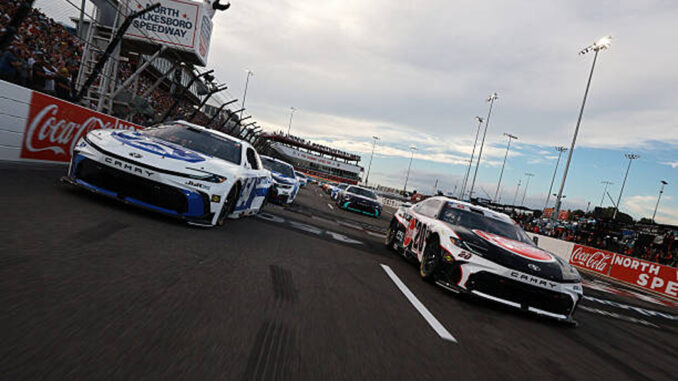
Beginning this weekend at Iowa Speedway, any natural caution with 10 laps or fewer remaining in a stage will immediately end that stage. No cleanup, no restart, no one- or two-lap mad dash to the green-and-white checkered flag. The caution itself becomes the stage break, and once the track is cleaned up, the next stage begins.
From a practical standpoint, it’s hard to argue with the reasoning.
The July Brickyard 400 turned into an exercise in patience, with fans watching what felt like an endless parade of caution laps around Indianapolis. NASCAR CEO Steve O’Donnell acknowledged the frustration, saying fans wanted fewer yellow-flag laps and more green-flag racing. His message was simple: NASCAR heard the complaints and is making a change.
Fair enough.
Nobody buys a ticket hoping to watch the pace car rack up laps while television commentators desperately search for new ways to describe a cleanup crew.
But every rule change comes with a price.
In this case, NASCAR is quietly eliminating one of the most unpredictable moments of a race.
Those one- or two-lap sprints to the end of a stage were pure motorsports caffeine. Crew chiefs suddenly had impossible decisions to make. Drivers who had been saving tires all stage suddenly drove like their rental agreement had expired. Stage points became a free-for-all, with three-wide dives into corners and aggressive blocks that probably made insurance agents break into a cold sweat.
They weren’t always pretty.
Sometimes they were downright ridiculous.
But they were almost always entertaining.
Yes, they occasionally produced another caution before the stage ended, adding even more yellow laps. That was the problem NASCAR wanted to solve. Yet there was something uniquely NASCAR about those frantic final laps. For a brief moment, the race transformed from a marathon into a backyard sprint where everyone forgot about tomorrow and worried only about the next 90 seconds.
Now, if the yellow comes out with eight laps to go in a stage, that’s it. The points are frozen, officials sort out the order using scoring loops and video replay, and everyone resets for the next stage.
It’s cleaner. It’s more efficient. Television will probably love it.
Whether fans will is another question.
The irony is hard to miss. NASCAR is making this change in the name of creating more green-flag racing, and over the course of an entire event, that’s likely exactly what will happen. Eliminating duplicate caution periods should put more racing back into the race.
Still, there will come a day when a caution flies with two laps left in a stage, and fans will instinctively expect one last all-out sprint before remembering those days are gone.
Sometimes progress makes perfect sense.
It just isn’t always quite as much fun.

Greg was a writer for DriveTribe supporting Amazon's The Grand Tour and has been published in major publications across the country including the Los Angeles Times, the Cleveland Plain Dealer and the Atlanta Journal-Constitution. He was also a contributor to Chicken Soup for the NASCAR Soul, published in 2010, and the Christmas edition in 2016. He wrote as the NASCAR, Formula 1, Auto Reviews and National Veterans Affairs Examiner for Examiner.com and has appeared on Fox News. He holds a BS degree in communications, and a Masters degree in psychology. He is currently the weekend Motorsports Editor for Autoweek and a regular contributor to Forbes.
- Corey Day is making a habit of ruining everyone else’s day - October 11, 2026
- Denny Hamlin salvaged his Sunday, but Larson stole the silverware - October 11, 2026
- Chase Briscoe tells the Chase field to shut up and listen - October 11, 2026