
The beauty of NASCAR’s new Chase format is nearing its full zenith after Phoenix.
For years, NASCAR’s knockout-style playoffs have had a rather unfortunate habit of turning championship contenders into spectators before the season was over. Drivers would spend months earning their place in the postseason, only to have their title hopes wiped out by a bad afternoon, a mechanical failure, or the sort of racing incident that makes a grown man stare into the middle distance and question every life choice that brought him here.
By this point last season, the field had been whittled down to just eight drivers eligible for the big prize. Everyone else was effectively playing for pride, points, and whatever consolation prize NASCAR might have tucked away in the merchandise trailer.
Not this year.
With just three races remaining in the 2026 season, all 16 drivers in the Chase are still mathematically eligible to win the championship. Sure, the odds of 16th-place Ryan Preece mounting an epic comeback are roughly the same as my summiting Mount Everest without first discovering a sudden passion for oxygen deprivation. But he is, in fact, still in it.
And that is rather the point.
NASCAR hasn’t invented something entirely new here. The sport used a version of this Chase format from 2004 through 2013, before deciding that what championship racing really needed was a series of elimination rounds and a winner-take-all finale. The knockout format had its moments, certainly, but it also had a habit of making the championship picture considerably smaller before the season was finished.
Now, with the return of the 16-driver Chase, NASCAR has rediscovered the rather splendid idea that a championship battle can be more interesting when more than a handful of drivers have a legitimate reason to care.
And after Phoenix, that idea is looking rather clever indeed.
Heading into last weekend, Kyle Larson appeared to have the championship more or less under control. The defending series champion, who won the title under last year’s knockout format, had built a 49-point lead and was doing the sort of thing championship contenders are supposed to do: winning races, finishing well, and making everyone else wonder whether they were competing for second place.
Then Sunday happened.
As is often the case in big-time stock car auto racing, fate decided to lob a wrench into the works of Larson and Hendrick Motorsports’ otherwise gilded plans. The trouble started Saturday, when Larson struggled in practice and qualifying. Sunday offered little in the way of redemption. He languished deep in the field for much of the race, but as the laps wound down, he began clawing his way forward.
For a while, it looked as though the damage might be manageable. Larson had worked his way into the top 20, and while that wasn’t exactly the sort of afternoon that gets immortalized in championship documentaries, it might have been enough to keep his points lead reasonably comfortable.
Then one of his tires decided it had had quite enough.
With just a few laps remaining, Larson slammed into the outside wall and was soon being hauled back to the garage by a tow truck. His afternoon was over, his Chevrolet was considerably worse for wear, and his championship campaign had suffered its third DNF of the season.
For Larson, his team, and his fans, it was a miserable afternoon. For the rest of the Chase field, however, it was rather like someone had finally opened the curtains in a room that had been dark for weeks.
Out of respect, naturally, they should probably avoid celebrating too loudly in Larson’s presence.
He left Phoenix with a five-point lead. Five. That’s not a championship cushion so much as a small deposit on one. It can disappear with a poor pit stop, an ill-timed caution, or a driver discovering that the right-front tire has suddenly developed an ambition to occupy the same space as the wall.
Suddenly, the other 15 drivers have something they hadn’t enjoyed much of during the opening seven races of the Chase: genuine hope.
And the storylines are plentiful.
Christopher Bell and Chase Briscoe would both make deserving champions. They’re fast, young, capable drivers who have spent the season proving they belong among the sport’s best. Either one lifting the trophy would be a perfectly respectable outcome, even if NASCAR’s marketing department might have to scramble to update a few graphics.
Then there’s Denny Hamlin, who dropped three positions in the Chase standings after his own miserable afternoon at Phoenix. Hamlin is a future Hall of Famer who has won just about everything there is to win in NASCAR, with one rather conspicuous exception. A Cup Series championship remains the missing piece, and with his career advancing toward its later chapters, the opportunity to finally put that particular ghost to rest would make for one heck of a story.
Tyler Reddick, meanwhile, won at Phoenix and has already demonstrated what he can do when everything comes together. The 23XI Racing driver was hotter than the sun early in the season, winning the Daytona 500 and establishing himself as one of the championship favorites. A late-season winning streak would be a fitting way to remind everyone that his early-season form wasn’t some elaborate automotive hallucination.
And then there’s Carson Hocevar.
Under last year’s elimination format, Hocevar would almost certainly be watching the championship battle from the sidelines by now. This year, he remains mathematically alive. If the drivers ahead of him begin tripping over their own feet, he could theoretically make a run all the way to the title.
Hocevar would be a popular champion among plenty of fans, although the season-ending banquet could become a rather awkward affair if the other drivers decided that celebrating his success wasn’t high on their list of priorities.
Of course, much of this is speculation. Championship mathematics can make almost anything look possible if you squint hard enough, and there is a difference between being mathematically eligible and being a realistic title contender.
But that’s what makes this format interesting. It gives the field something to race for, even if some drivers need a small miracle, a large points swing, and a few competitors to have the sort of afternoon usually reserved for slapstick comedy.
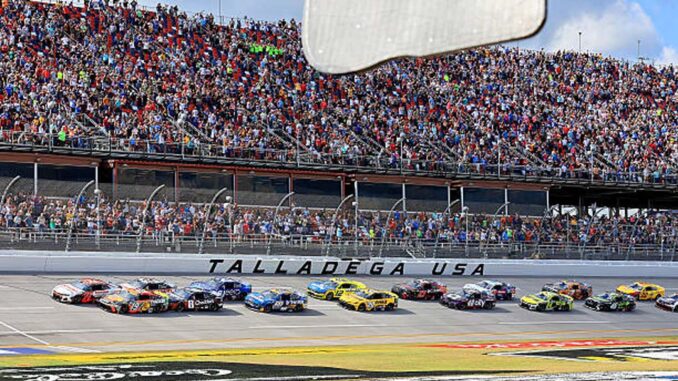
This week, NASCAR heads to Talladega Superspeedway, where unpredictability is less a possibility than a standard operating procedure. The cars will be hurtling around in a giant aerodynamic washing machine, and one poorly timed bump can turn a perfectly sensible afternoon into a very expensive game of bumper cars.
Talladega could tighten the standings further. It could also deliver the sort of spectacular chaos that leaves several championship hopefuls wondering where their afternoon went. Either way, the race should make for compelling viewing because there is so much more at stake than simply who gets to celebrate in Victory Lane.
And that is the beauty of this Chase.
NASCAR spent years trying to manufacture championship drama by eliminating contenders. Now it has a format in which the drama can come naturally, from the racing itself. A bad afternoon doesn’t necessarily end a championship campaign, and a good one can transform a driver from an outside chance into a genuine threat.
There are still plenty of ways this could go wrong. Someone will almost certainly complain about the points system, and there will be those who argue that a champion should be decided by an entirely different method. NASCAR fans could find a reason to argue about the color of the sky if the sanctioning body announced that it was blue.
But for now, all 16 drivers remain in the hunt, three races remain on the calendar, and the championship is suddenly wide open.
Think about that for a moment. With just three races left in the season, NASCAR has managed to keep every Chase driver mathematically eligible for its biggest prize. Not eight. Not four. All 16.
It hasn’t needed a last-lap gimmick, an artificial elimination round, or some convoluted scheme to manufacture a championship fight. It simply brought back a format that gives drivers room to recover from a bad day and gives fans a reason to keep watching.
Which brings us to Talladega, where the only thing more unpredictable than the racing is the likelihood that someone will emerge from the weekend wondering how a perfectly good championship campaign wound up upside down in a cloud of tire smoke.
Three races. Sixteen contenders. One trophy.
For once, NASCAR doesn’t have to manufacture the drama. It just has to get out of the way and let the racing happen.

Greg was a writer for DriveTribe supporting Amazon's The Grand Tour and has been published in major publications across the country including the Los Angeles Times, the Cleveland Plain Dealer and the Atlanta Journal-Constitution. He was also a contributor to Chicken Soup for the NASCAR Soul, published in 2010, and the Christmas edition in 2016. He wrote as the NASCAR, Formula 1, Auto Reviews and National Veterans Affairs Examiner for Examiner.com and has appeared on Fox News. He holds a BS degree in communications, and a Masters degree in psychology. He is currently the weekend Motorsports Editor for Autoweek and a regular contributor to Forbes.
- NASCAR’s old Chase format is making the championship fun again - October 19, 2026
- Denny Hamlin’s Phoenix escape plan gets a speeding ticket - October 18, 2026
- Kyle Larson’s tire wasn’t the only thing to go flat at Phoenix - October 18, 2026