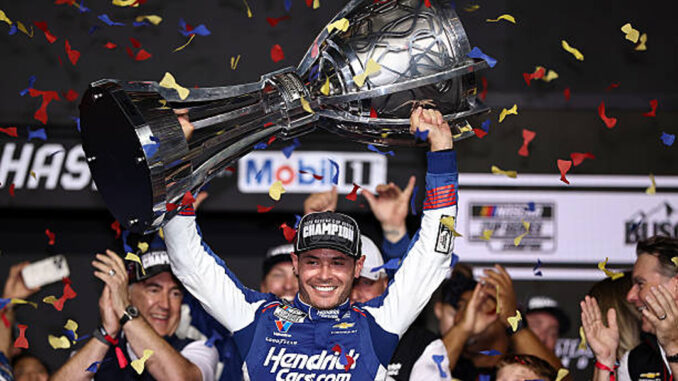
The 2026 NASCAR Cup Series championship was over before the race had really gotten started. And Kyle Larson found out in a manner that was about as exciting as receiving a notification that your electricity bill is due.
With fewer than 10 laps remaining in Stage One of Sunday’s season finale at Homestead-Miami Speedway, the engine in polesitter Chase Briscoe’s Toyota decided it had endured quite enough of the 2026 season. It let go in spectacular fashion, leaving a trail of smoke along the frontstretch and bringing out the caution.
The timing couldn’t have been better for Larson.
Tyler Reddick was leading when the stage ended, with Larson running fourth. Just a couple of laps earlier, Larson had passed championship rival Denny Hamlin and was working on another title contender, Christopher Bell, for third when Briscoe’s mechanical failure interrupted the proceedings.
That fourth-place stage finish was enough. NASCAR officially declared Larson the 2026 Cup Series champion, ending the championship battle with 188 laps still remaining in the race.
“Uh, they’ve declared it,” crew chief Cliff Daniels informed Larson over the team radio.
“Like it’s done?” Larson asked.
“We’ve got it,” Daniels replied.
“OK. That was a little anticlimactic,” Larson said.
Understatement of the afternoon.
The trophy might have been awarded with more than 180 laps still on the scoreboard but getting Larson to that moment required a postseason that tested just about every part of the No. 5 team’s operation.
NASCAR brought back the Chase in 2026, featuring a single points reset after the regular season, a 16-driver field and 10 races without eliminations. Wins were worth 55 points, but stage points and avoiding disastrous afternoons were just as important.
Larson managed to turn the new format into something of a personal points-collecting exercise. He just needed most of the regular season to rediscover his winning touch.
Winless through the opening 26 races, Larson carried a 51-race victory drought into September. Meanwhile, Hamlin entered The Chase as the top seed, 55 points ahead of Larson, who was seventh. There was plenty of speed in the No. 5 Hendrick Motorsports Chevrolet, but converting that speed into consistent results had become something of a problem.
There was another challenge. Chevrolet’s new Camaro ZL1 had made its competition debut at the beginning of the season, and Larson admitted afterward that the team struggled to get comfortable with the new car.
“The Chevrolet was just hard to get used to in the beginning,” Larson said. “We all worked really hard at Hendrick Motorsports, Chevrolet. We were just building.”
That changed at Gateway, where Larson ended his drought in the second race of The Chase. From there, the No. 5 team began producing the kind of performances that make championship competitors nervous.
Larson opened the postseason with finishes of fifth, first, second, first and second. His 2.2 average finish through those five races was the best start in Chase history, according to Racing Insights. He collected 273 points during that stretch, averaging 54.6 per race and nearly doubling his regular-season scoring pace.
At Kansas Speedway, Larson swept both stages, led 235 laps and collected the maximum 76 points. At Las Vegas, a 26-second pit stop dropped him a lap down, but Larson and Daniels managed to claw their way back to a second-place finish.
The Kansas performance was a demonstration of raw speed and execution. The recovery at Las Vegas was something else entirely: a team refusing to let one painfully slow pit stop dictate the outcome of its afternoon.
Daniels deserves considerable credit for the transformation. During the winless stretch, he acknowledged that the team had occasionally overreached in its search for speed. Rather than panic or reinvent the operation, he kept the group focused on rebuilding around the fundamentals that had made it successful.
After Charlotte, Daniels summed up the philosophy rather neatly.
“I feel like it’s us against us, and it’s always been that way,” he said.
Larson had plenty of reasons to appreciate that approach. When asked after securing his third championship what made this title different, he immediately pointed to the man sitting atop the pit box.
“It’s just a true testament to Cliff’s leadership, honestly,” Larson said. “We would not have a single championship without him. I am so thankful to have him in my corner.”
Then the trip to Arizona turned a comfortable championship situation into a rather unpleasant mathematical exercise.
Larson’s sixth-place finish at Charlotte ended a run of five consecutive top-five results. A week later, handling problems and a tire failure at Phoenix sent him tumbling to 34th, earning just three points. His 49-point championship lead evaporated to five, with seven drivers suddenly separated by just 56 points.
Suddenly, Larson had company. Several championship contenders were within striking distance, and the schedule offered little comfort for a driver who had never won on a superspeedway.
Yet Talladega became one of the defining moments of his career.
Larson had gone winless in his previous 58 drafting-track starts. At Talladega, he led 23 laps, collected 16 stage points and then dropped from the lead to 11th on the final lap. What followed was an extraordinary charge back through the tri-oval, giving him his first career superspeedway victory and a massive 71-point afternoon.
His championship advantage jumped from five points to 73 in a single race.
Some of that separation came courtesy of his competitors, as all 15 other Chase drivers encountered trouble at Talladega, including tire failures, pit-road mistakes and crashes. But Larson and the No. 5 team had put themselves in position to take advantage, collecting points, surviving the chaos and making the decisive move when it mattered.
Martinsville was the last opportunity for Larson’s championship cushion to disappear before the finale.
Larson went a lap down after an unsuccessful opening-stage strategy and failed to score a single point in either of the first two stages. A caution following contact that sent Joe Gibbs Racing teammates Bell and Hamlin spinning allowed Larson to get the free pass. He eventually recovered to finish ninth and collect 28 points.
It wasn’t pretty, but it was enough.
Larson arrived at Homestead with a 67-point advantage over Bell and 70 over Hamlin. He needed just nine points, or a 28th-place finish without stage points, to guarantee the championship.
Briscoe’s engine failure simply saved everyone the trouble of waiting.
For Larson, the latest championship was a different experience from the first two, even if there were some similarities to the way the team finished the previous season.
“All three mean something way different,” Larson said. “The first one being your first. Doing the way we did was extra special. Then last year, we started off the year really hot. Just declined kind of throughout the regular season. But then steadied out in the Playoffs. Again, with Cliff’s leadership, kept us in it, to be able to attack when we needed to, get the surprise of that championship.”
In 2021, Larson won 10 races and led 2,581 laps, overwhelming the competition in his first season with Daniels as crew chief before winning the championship race at Phoenix.
In 2025, Larson didn’t lead a single lap at Phoenix. Instead, a late caution and a two-tire strategy from Daniels helped him finish third and secure the championship as Hamlin’s dominant afternoon unraveled.
This year required something different.
“This one, I mean, it’s somewhat similar, but such a different format that really takes consistency,” Larson said.
He admitted that even after the team began finding its footing, he didn’t anticipate the kind of postseason performance that ultimately delivered another championship.
“I could feel we were okay, but I definitely didn’t think we would go on the run we did in this final 10 weeks,” Larson said. “To get three wins, be as consistent as we were, it’s just a true testament to Cliff’s leadership, honestly.”
That leadership, Larson explained, extends well beyond finding speed in the race car. Daniels has maintained high expectations without allowing the team to lose its enthusiasm, even during the frustrating stretches.
“He just holds such a high standard, but in a good way, for us,” Larson said. “He just keeps us positively motivated. It just gives us a fuel that burns throughout the whole year.”
Perhaps most tellingly, Larson said he never felt burned out, even when the results weren’t coming.
“I never once felt burnt out this year, not once, not even through the tough times we were having. He just gave me a lot of confidence,” Larson said.
“I knew whenever it came together, we would be ready. I just didn’t know it would be this year and at the time that it was.”
The third title also gives Larson a rather interesting place in NASCAR history. He becomes the 11th driver to win at least three Cup titles and the first since Jimmie Johnson to claim consecutive championships. Johnson, naturally, won five straight between 2006 and 2010, setting a standard that still looks almost ridiculous.
For Daniels, the championship carries additional significance. He was a race engineer on Johnson’s 2016 championship team before becoming Larson’s crew chief, connecting two generations of Hendrick Motorsports title winners.
Hendrick’s 16th Cup championship extends an organizational record that began with Jeff Gordon in 1995. Gordon won four titles, Johnson collected seven, Terry Labonte and Chase Elliott each earned one, and Larson now has three.
The No. 5 Chevrolet also has a history worth remembering. Geoff Bodine drove it to victory at Martinsville in April 1984, a win that helped keep Rick Hendrick’s fledgling racing operation alive. Forty-two years later, the same number has delivered another championship.
Chevrolet also celebrates its 35th driver championship in NASCAR’s premier series, its fourth in the past seven seasons and the second consecutive title for the Camaro ZL1. The 2026 championship-winning car made its competition debut this season, which isn’t a bad way to introduce yourself.
Larson’s third title is another remarkable accomplishment, but perhaps the most impressive part is how differently he got there. The first came through domination. The second required surviving the moment that mattered most. The third demanded consistency, resilience and the ability to recover when an increasingly comfortable championship lead disappeared.
After the championship was official, Larson also made sure to recognize the people who helped make it happen, including the mechanics in the race shop who don’t always get to experience the celebrations firsthand.
“What a year,” he said. “Bringing the Chase back was exciting. Just proud of this team. It’s going to be fun to celebrate with everybody tonight. All of our families, wives, girlfriends, significant others, mechanics in the race shop that don’t get to come often.”
He also thanked the fans who stuck with the sport throughout the season before offering a final thought that suggested three championships might not be nearly enough.
“Let’s go get some more.”
And then, just for good measure, it all ended with a blown Toyota engine and a radio conversation that sounded more like someone confirming a lunch reservation than announcing a NASCAR champion.
“OK. That was a little anticlimactic.”
Yes, Kyle. It certainly was. But nobody is going to ask you to give the trophy back.

Greg was a writer for DriveTribe supporting Amazon's The Grand Tour and has been published in major publications across the country including the Los Angeles Times, the Cleveland Plain Dealer and the Atlanta Journal-Constitution. He was also a contributor to Chicken Soup for the NASCAR Soul, published in 2010, and the Christmas edition in 2016. He wrote as the NASCAR, Formula 1, Auto Reviews and National Veterans Affairs Examiner for Examiner.com and has appeared on Fox News. He holds a BS degree in communications, and a Masters degree in psychology. He is currently the weekend Motorsports Editor for Autoweek and a regular contributor to Forbes.
- NASCAR adds horsepower and makes a few other welcome adjustments for 2027 - November 20, 2026
- 2027 NASCAR silly season tracker: Who’s going where? - November 18, 2026
- NASCAR adds a 200-mph qualifying twist to The Clash - November 18, 2026