
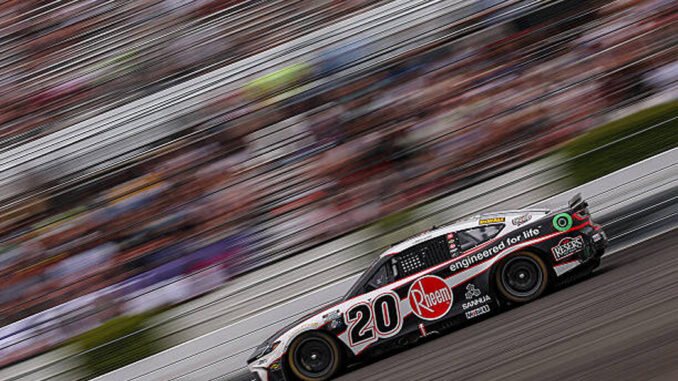
Christopher Bell arrived at Pocono needing something good to happen.
Anything, really.
He came in winless on the season, carrying a freshly broken wrist from that hard Michigan crash a week ago, and trying to drag both himself and the No. 20 Joe Gibbs Racing team out of what had become a fairly miserable stretch.
By Sunday afternoon, good wasn’t available.
So Bell and company reached for improbable.
After pitting with 51 laps remaining, the No. 20 team committed to a fuel strategy that looked questionable at first, ridiculous in the middle, and for one brief, glorious moment looked like absolute genius.
The blueprint wasn’t new. Joe Gibbs Racing teammate Chase Briscoe pulled off fuel-saving wizardry here a year ago.
Bell’s version just required going farther.
About ten laps farther.
As the field cycled through stops, Bell suddenly found himself leading Denny Hamlin by more than 11 seconds while driving like there was an egg under the throttle pedal and a very angry accountant in the passenger seat.
Inside the car, Bell tried not to get ahead of himself.
“I didn’t know what to think,” Bell said afterward. “I was just trying to stay open-minded and do my job inside of our Rheem Camry.”
But eventually the radio started delivering dangerous information.
“Obviously, when they start telling me that we’re getting good gas mileage and we are in good position, I’m starting to get excited in there…”
That’s the problem with hope.
It shows up.
Bell knew the gamble was worth taking because the alternative wasn’t exactly inspiring.
“We were mired back in the 20s, and so I think it was an amazing gamble,” Bell said. “The situation is so hard, because you don’t know if you are racing for the win, or if you are racing to finish the race.”
And Bell committed.
He kept shifting deep into the run to save fuel.
“I didn’t stop shifting until about 10 to go – I left it in fifth,” he explained.
That balancing act became the whole race.
Push too hard and you run dry.
Save too much and surrender track position.
Bell admitted afterward he could have backed the pace down further and maybe salvaged a lower top-10 finish, but that wasn’t the point.
“I certainly could have given up more pace and fallen back and maybe finished outside of the top-10, and it would have been a net gain, but we ended up about where we were going to be.”
Meanwhile, Hamlin was coming.
No panic.
No drama.
Just giant bites disappearing from the interval.
Seven laps to go.
2.6 seconds.
Crew chief Adam Stevens was already doing race engineer math over the radio.
“We’ll probably slide in P4 if we did enough saving.”
Spotter Tab Boyd simplified the mission: Just make it.
Spoiler alert: they did not.
Hamlin drove by with four laps remaining.
Coming to the white flag, Bell’s Toyota finally coughed, stumbled, and surrendered.
Twenty-sixth.
Which sounds terrible until you remember where Bell started the afternoon emotionally.
And through all of it, Bell said physically the car mostly felt manageable despite the wrist.
“Whenever the field got strung out, I felt fine. Running by myself, I felt like it was normal,” Bell said.
The trouble came when racing got chaotic.
“People were making quick moves on restarts or you get put three-wide, the car gets loose – those are very difficult… restarts were very difficult.”
So no, Bell didn’t get the miracle.
But for a few laps Sunday at Pocono, a wounded driver and a mathematically suspicious fuel strategy made everybody believe.
That counts for something.

Greg was a writer for DriveTribe supporting Amazon's The Grand Tour and has been published in major publications across the country including the Los Angeles Times, the Cleveland Plain Dealer and the Atlanta Journal-Constitution. He was also a contributor to Chicken Soup for the NASCAR Soul, published in 2010, and the Christmas edition in 2016. He wrote as the NASCAR, Formula 1, Auto Reviews and National Veterans Affairs Examiner for Examiner.com and has appeared on Fox News. He holds a BS degree in communications, and a Masters degree in psychology. He is currently the weekend Motorsports Editor for Autoweek and a regular contributor to Forbes.
- Corey Day is making a habit of ruining everyone else’s day - October 11, 2026
- Denny Hamlin salvaged his Sunday, but Larson stole the silverware - October 11, 2026
- Chase Briscoe tells the Chase field to shut up and listen - October 11, 2026