
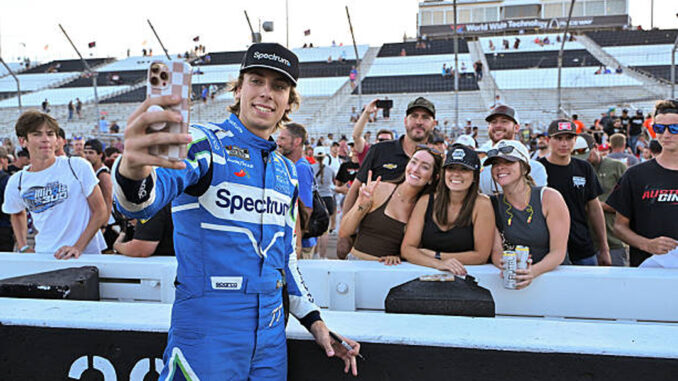
There are plenty of reasons to want to win the Bristol Night Race.
There’s the trophy, which looks like something a medieval king might use to settle an argument. There’s the money. There’s the prestige. There’s the rather satisfying prospect of spending Sunday morning knowing you have beaten several dozen other people at the thing they are supposedly very good at.
And then there are the fans.
Carson Hocevar seems to have figured out that they are rather important.
While NASCAR drivers have become increasingly accessible through social media, television appearances and carefully scheduled autograph sessions, Hocevar has developed a wonderfully simple approach to fan interaction.
If they’re there, he goes to them.
Last weekend at World Wide Technology Raceway, Hocevar finished his race obligations and heard fans cheering nearby. He initially thought they were cheering for Kyle Larson. Then he realized they were cheering for him.
So he walked over.
The fans moved closer.
And Hocevar started signing autographs.
“I was like, well, I’m not going to say no,” Hocevar said Friday at Bristol Motor Speedway. “I can’t just be like, oh, I’m apparently blind and deaf, I don’t hear you.”
That is probably the most sensible approach anyone in professional sports has taken to a crowd in quite some time.
Hocevar knows what it feels like to be on the other side of the fence, because he was that kid.
His first memories of racing came at Kalamazoo Speedway, where he would wait for the final race of the night because he knew that when it was over, the fans could get down into the pits.
“I’ve always loved that,” he said. “I grew up doing that, and I remember how fun it was. I think, ultimately, I enjoyed going to the racetrack sometimes more because I got to be in the pits around all those people.”
There’s something refreshing about hearing a Cup driver talk about the fans as though they are actual human beings rather than an important demographic in the NASCAR consumer engagement strategy.
Hocevar remembers being about five years old and pretending he was 35. Now he is the 23-year-old Cup driver those five-year-olds are pretending to be.
And he clearly understands the responsibility that comes with that.
At Darlington, one fan had gone considerably beyond simply bringing a hat or a hero card for Hocevar to sign. The family had built an electric car to resemble his Spire Motorsports Cup car and brought it to the track.
“That stuff’s just fun,” Hocevar said. “The fact they take the time to do that, bring it to the track and haul it there, is super cool for me.”
This is where the Bristol Night Race becomes particularly appropriate.
Bristol is one of those events NASCAR doesn’t really have to explain. The fans are close enough to the racing that subtlety becomes somewhat unnecessary, the track looks magnificent under the lights and the entire place has the feeling of a sporting event that has been allowed to get slightly out of hand.
Hocevar loves it.
His crew chief, Luke Lambert, considers it his favorite race of the year, and Hocevar has already accumulated some good memories at the place. More importantly, Bristol suits the way he likes to drive.
He can move around.
He can run the bottom.
He can run the top.
And if necessary, he can exploit the sort of instincts that come from spending enough time watching dirt racing to understand why the car sometimes wants to behave like a badly trained shopping cart.
“I feel like I watch enough dirt racing that I can kind of understand it,” Hocevar said. “I really love that you can run the top and get a huge run, as well as run the bottom.”
There is another reason Hocevar is enjoying Bristol this year. The NASCAR Cup Series Chase is only two races old, and the new/old format has already produced the sort of tension NASCAR presumably hoped it would.
Hocevar, however, isn’t interested in obsessing over the standings.
He tried not to look at the points before the Chase began. Unfortunately, they appeared on an Excel spreadsheet during a team debrief.
“Dang it,” he remembered thinking.
Since then, he has tried to ignore them.
The reasoning is refreshingly uncomplicated. Race the entire field, finish as far forward as possible and let the points figure themselves out.
After all, one loose wheel can destroy a driver’s afternoon while somebody else crashes and suddenly hands him a pile of points.
“It can just flip like that,” Hocevar said.
The intensity of the Chase has already been obvious to him. Drivers who might normally settle for eighth place are suddenly fighting as though eighth is a matter of life and death because every position matters against another Chase driver.
“There are no more resets, there’s no more get backs,” Hocevar said. “You don’t know when your mulligan’s going to happen.”
That may be the best description yet of NASCAR’s new system.
And perhaps Hocevar has found the best way to navigate it: don’t spend too much time worrying about the scoreboard.
Drive the car.
Enjoy Bristol.
And when the race is over, if there are fans standing nearby hoping for an autograph, go sign one.
After all, Hocevar knows exactly what that kid on the other side of the fence is feeling.
He used to be him.

Greg was a writer for DriveTribe supporting Amazon's The Grand Tour and has been published in major publications across the country including the Los Angeles Times, the Cleveland Plain Dealer and the Atlanta Journal-Constitution. He was also a contributor to Chicken Soup for the NASCAR Soul, published in 2010, and the Christmas edition in 2016. He wrote as the NASCAR, Formula 1, Auto Reviews and National Veterans Affairs Examiner for Examiner.com and has appeared on Fox News. He holds a BS degree in communications, and a Masters degree in psychology. He is currently the weekend Motorsports Editor for Autoweek and a regular contributor to Forbes.
- Kyle Busch’s legacy gets a smoky exclamation point in Charlotte - October 10, 2026
- Photos: Kyle Busch Celebration of Life at Charlotte Motor Speedway Friday Oct. 9, 2026 - October 10, 2026
- Layne Riggs gives Honeycutt a Charlotte-sized championship headache - October 9, 2026