
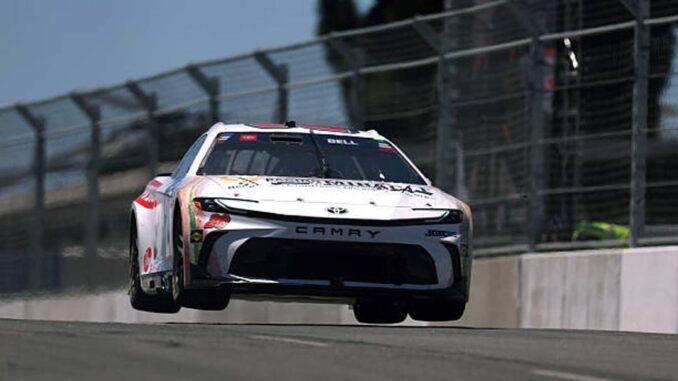
Brent Crews didn’t so much get a Cup Series debut as he got a very expensive fire drill with NASCAR logos on it Sunday.
The plan inside Joe Gibbs Racing’s No. 20 Toyota was already wobbling before the green flag even thought about dropping. Christopher Bell, still recovering from a fractured wrist and clearly still in “we’ll see how this goes” territory after Michigan, started the race but wasn’t meant to finish it. So when Ricky Stenhouse Jr. parked his No. 47 Chevrolet on Lap 12, the yellow flag didn’t just slow the field down. It opened the door for a driver swap on a closed pit road at a street course where everything already feels like it’s held together with zip ties and optimism.
Bell dove onto pit road under caution, climbed out, and handed the wheel to Crews, the 18-year-old who had already spent the weekend bouncing between NASCAR’s O’Reilly Auto Parts Series and anything else Joe Gibbs Racing could find for him to sit in. Somewhere in there, he went from “prospect” to “oh, you’re driving a Cup car now.” No warm-up laps. No long introduction. Just go.
For a few minutes, it almost looked survivable. Then Lap 30 happened.
The No. 20 Toyota broke, plain and simple, ending the experiment early and leaving Crews with a Cup Series stat line that reads more like a typo than a résumé entry. Bell, officially the driver of record, will still collect the single point and the 39th-place finish, which feels like the kind of consolation prize you get handed while everyone quietly avoids eye contact.
Crews, meanwhile, got his first real Cup Series race laps in the same way people usually get their first real job experience: with nobody entirely sure if the equipment was going to last the shift.
Afterward, he didn’t sound like someone trying to spin a dream debut into something it wasn’t. He sounded like someone still trying to reverse-engineer what exactly just happened.
“I was kind of going through the gears and it just broke,” Crews said. “I’m not really sure. I’m going to have to have Adam (Stevens, crew chief) to look over it and myself to figure out if it was something I did or if it was just a freak accident. Once I look at it I’ll have more answers. It’s really unfortunate for this whole team. We came here to get points and coming out with not much.”
There was at least some perspective buried in the disappointment, which is impressive given the circumstances.
“It was a great opportunity to come and learn and try and help these guys out,” he added.
The challenge, as he explained it, was exactly what you’d expect when you drop someone out of a lighter, more forgiving O’Reilly Series car and into a Cup machine that behaves like it’s been personally offended by physics.
“I had three laps I think in the Cup car and five in the O’Reilly car, so it was just trying to learn to the best of my ability,” he said. “They are a lot different, the grip level is a lot less in the Cup car, but it’s got a lot of brakes but right after that it falls off and you don’t see that as much in the O’Reilly car.”
Which is one way of saying the Cup Series doesn’t ease you in. It throws you in, watches you blink twice, then checks your lap times.
By the time it was over, Joe Gibbs Racing had cycled through a driver change, a mechanical failure, and a very short-lived debut for a teenager who probably expected his first Cup laps to come with slightly fewer plot twists.
Instead, it became one of those NASCAR footnotes that looks simple on paper and feels like chaos in real time.

Greg was a writer for DriveTribe supporting Amazon's The Grand Tour and has been published in major publications across the country including the Los Angeles Times, the Cleveland Plain Dealer and the Atlanta Journal-Constitution. He was also a contributor to Chicken Soup for the NASCAR Soul, published in 2010, and the Christmas edition in 2016. He wrote as the NASCAR, Formula 1, Auto Reviews and National Veterans Affairs Examiner for Examiner.com and has appeared on Fox News. He holds a BS degree in communications, and a Masters degree in psychology. He is currently the weekend Motorsports Editor for Autoweek and a regular contributor to Forbes.
- NASCAR’s old Chase format is making the championship fun again - October 19, 2026
- Denny Hamlin’s Phoenix escape plan gets a speeding ticket - October 18, 2026
- Kyle Larson’s tire wasn’t the only thing to go flat at Phoenix - October 18, 2026