
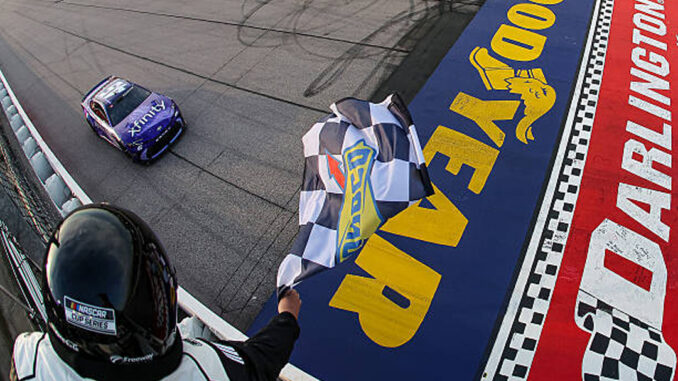
Before the final stage of Sunday’s Goodyear 400 at Darlington Raceway, crew chief Billy Scott laid out alternatives to driver Tyler Reddick.
By then, Scott and the crew of Reddick’s No. 45 23XI Racing Toyota already had replaced the battery in the car, but there was still concern that the new, larger battery wouldn’t be able to maintain sufficient voltage over the final run.
“We believe it was a charging issue,” Scott said after the race. “We tried to diagnose that through Stage 1. Believed the alternator for some reason when he hit that bump off Turn 2 quit working.
“From that point on, it was just a matter of managing the amount of amperage the battery had. So, yes, the battery we replaced it with was a bigger battery, heavier. It had more capacity. That enabled us to get to the end.
“Yes, he had to start turning things off. We went through the first two stages of his running his cool shirt, not his air conditioner, and a back-flowing fan.”
With the cool shirt working, Reddick had some degree of comfort on a hot day in Darlington. That changed with the final stage.
“Then when we got to Stage 3, (we) evaluated where our voltage was at that point,” Scott said. “Left it up to him: just cut everything off and battle from fifth to try to win and get to the end on the battery we have left, or come in and change batteries one more time and go to the back in 25th and be able to cool himself.
“He ultimately elected to, ‘No, give me the track position, I’ll turn everything off and deal with it.’ And it worked out.”
Essentially, the choice was to suffer without the use of the cool shirt and try to win the race, or pit for a new battery and give up the track position Reddick had regained after the first battery change.
Reddick is a racer—so there really wasn’t a choice at all.
“It took everything,” said Reddick, who had finished second at Darlington three times, most recently in last year’s Southern 500. “All of my seconds, thirds, fourths—all of my what-could-have-been days and nights here at Darlington—motivated me to fight through it.
“I was just of that mind-set where I was willing to sacrifice everything to win this race. I wasn‘t going to let issues with the car… I wasn’t going to let anything get in the way of that… I was willing to pass out in the car, if I had to, to win the race. I just had to gut it out.”
As it turned out, Reddick won going away—by 5.847 seconds over runner-up Brad Keselowski, who won the first two stages and led a race-high 142 laps to Reddick’s 77.
Before the Darlington race, Reddick already had made an indelible entry in the NASCAR record book. With victories at Daytona, EchoPark (Atlanta) and Circuit of the Americas (Austin, Texas), he became the first driver to win the first three races of a NASCAR Cup Series season.
The win at Darlington adds another remarkable accomplishment to an already remarkable season. Only Dale Earnhardt in 1987 and Bill Elliott in 1992 had won four of the first six races in a Cup season—until Reddick joined the club on Sunday.
Reddick heads to next Sunday’s Cook Out 400 at Martinsville Speedway (3:30 p.m. ET on FS1, MRN and SiriusXM NASCAR Radio) with a staggering 95-point series lead over second-place Ryan Blaney, who finished third at Darlington.
Reddick’s margin over third-place Bubba Wallace, his 23XI Racing teammate, is 120 points. Collected in a Lap 111 wreck and relegated to a 34th-place finish, Wallace lost 59 points to Reddick on Sunday.
Even though only six of the first 26 races have been run, the top seeding in the 10-race Chase has to be classified as ‘Reddick’s to lose.’

- Kyle Larson had a hunch and, as it turns out, he was right - September 14, 2026
- Hendrick Motorsports isn’t developing Corey Day. It’s building him - September 12, 2026
- Brad Keselowski says Carson Hocevar needs to touch the hot stove - September 12, 2026