Rain, sleet and snow might slow things down, but NASCAR finally got it done. And when it finally did get done at Bowman Gray Stadium, it did so in the most Bowman Gray way imaginable—sideways, chaotic, slightly unhinged, and absolutely glorious.
The Clash, postponed from Sunday after North Carolina decided to audition for the Winter Olympics, finally came to life on a damp, miserable Wednesday night. What followed was not so much a race as a rolling physics experiment conducted on a quarter-mile slab of asphalt that had no interest whatsoever in cooperating. Grip was optional. Survival was not.
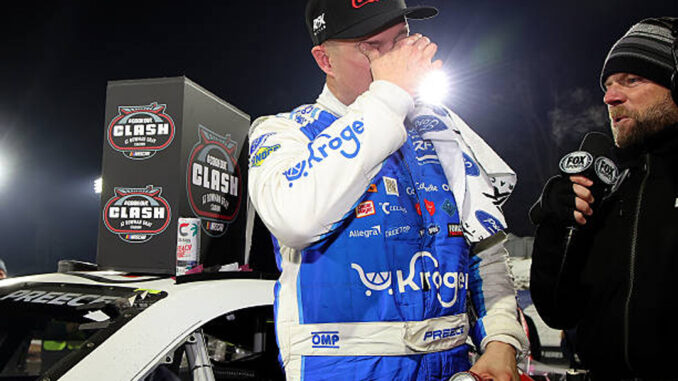
When the smoke, spray, and assorted sheet metal finally cleared, it was Ryan Preece standing in Victory Lane, somehow. Preece wheeled the No. 60 RFK Racing Ford to the lead for good on Lap 156 and stayed there, despite having earlier been involved in multiple incidents that, on most nights, would have sent a driver packing with a bent race car and a bad mood. Instead, he led 46 of 200 laps and won a Cook Out Clash that will be remembered less for strategy and more for sheer stubbornness.
This was a race where 23 of NASCAR’s best spent most of the evening trying not to hydroplane into the nearest immovable object. The result was a Clash-record 17 cautions, which sounds excessive until you remember that Bowman Gray in the dry is already a contact sport. Add sleet, standing water, and Goodyear wet-weather tires, and it became automotive bumper cars with consequences.
Ty Gibbs reached the scheduled halfway break at Lap 100 as the leader, which normally would be a nice, tidy milestone. Instead, the red flag turned into an extended weather seminar as sleet began falling on the track, following historic snowfall that had already forced the race off its original Sunday date. NASCAR, never shy about improvisation, adjusted tire strategy, dried what it could, and eventually waved the green again.
The restart at Lap 101 immediately reminded everyone that conditions were still very much a suggestion. Chase Briscoe surged past Gibbs on the outside, Denny Hamlin promptly slid sideways, collected polesitter Kyle Larson, and sent Larson spinning backwards into the Turn 4 SAFER barrier. Preece, not to be left out, spun behind them, because of course he did.
From there, the evening descended into a beautifully messy rhythm of short runs, bold moves, and sudden loss of control. Josh Berry, fresh off winning the Last Chance Qualifier earlier in the night, slid into the outside wall at Lap 119 and limped away with a right-front issue. Two laps after the restart, Austin Cindric—who also clawed his way in through the LCQ—lost it for the second time and parked his car squarely in the middle of the racing line, collecting teammates and competitors in equal measure.
Hamlin spun again at Lap 139 trying to pass Alex Bowman, then Austin Dillon spun off Hamlin’s front bumper on the ensuing restart. It was that kind of night: if you weren’t spinning, you were thinking about it.
Carson Hocevar briefly looked like the man who might tame the madness. He muscled his way to the front and led 18 laps, attacking the slick surface with youthful confidence and perhaps a bit too much optimism. A spin by Gibbs at Lap 144 placed the No. 54 Toyota directly in Hocevar’s path, tearing the front end off the No. 77 Chevrolet and sending Hocevar to the rear. Later, after more contact with Bubba Wallace, Hocevar spun yet again, his evening becoming a highlight reel of what not to do on wet concrete.
Shane van Gisbergen, the road-course ace, did what road-course aces tend to do when things get wet—move forward. SVG led twice for 15 laps and looked perfectly at home dancing through the puddles, until Chase Briscoe sent him around in Turn 3 late in the race, collecting Trackhouse Racing teammate Connor Zilisch in the process. Even the specialists weren’t immune.
The night’s first incident caution actually came back when conditions were still dry at Lap 54, when Wallace was spun in Turn 3 following a chain reaction involving Ryan Blaney, Ross Chastain, and Joey Logano. Compared to what followed, it felt almost quaint.
Up front, through all the chaos, Preece kept putting himself back in position. While others overreached or simply ran out of luck, Preece stayed aggressive without being reckless—a fine line on a night where the margin for error was about the width of a lug nut. When he took the lead late, he didn’t give it back.
By the time the checkered flag finally waved, it felt less like the end of a race and more like the conclusion of a shared ordeal. NASCAR had waited out snow, dodged sleet, bolted on rain tires, and somehow delivered a 200-lap feature at the Madhouse.
It wasn’t pretty. It wasn’t clean. It was loud, slippery, chaotic, and utterly perfect.
In other words, Bowman Gray Stadium did exactly what Bowman Gray Stadium does best.

Greg was a writer for DriveTribe supporting Amazon's The Grand Tour and has been published in major publications across the country including the Los Angeles Times, the Cleveland Plain Dealer and the Atlanta Journal-Constitution. He was also a contributor to Chicken Soup for the NASCAR Soul, published in 2010, and the Christmas edition in 2016. He wrote as the NASCAR, Formula 1, Auto Reviews and National Veterans Affairs Examiner for Examiner.com and has appeared on Fox News. He holds a BS degree in communications, and a Masters degree in psychology. He is currently the weekend Motorsports Editor for Autoweek and a regular contributor to Forbes.
- Bristol breaks Ryan Blaney’s heart the usual way - April 12, 2026
- Todd Gilliland quietly wins his own Bristol race - April 12, 2026
- Bristol does Bristol things and gives Ty Gibbs his long-awaited moment - April 12, 2026