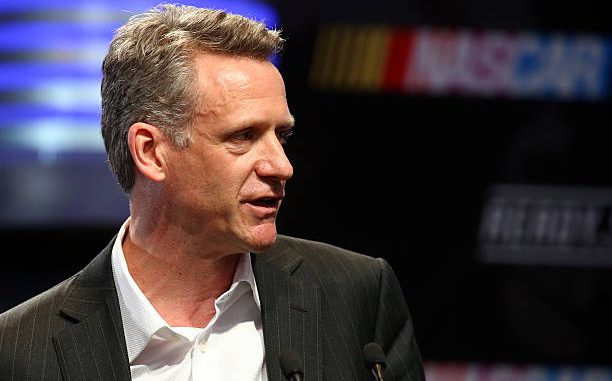
On Tuesday, NASCAR quietly slid a press release into the world announcing that Steve Phelps is “stepping away” from his role as Commissioner. No blinking red light. No emotional sendoff. Just a neatly scripted goodbye that read less like a celebration and more like the polite corporate version of someone clearing out their office before anyone asks too many questions.
NASCAR would very much like you to believe this was all perfectly tidy. The official announcement reads like a farewell toast at a corporate retreat: Steve Phelps, pillar of leadership, visionary steward of the sport, champion of innovation, bringer of light, slayer of dragons, and presumably the man who once single-handedly stopped a meteor from hitting Talladega. There are awards, adjectives, triumphant memories, more adjectives, and a reminder that absolutely everything is fine, stable, orderly, and just as planned.
And it might have landed cleaner if the past year hadn’t happened.
Because while the press release talks about growth, transformation, and global vision, everyone in the garage, the grandstands, and basically anywhere racing fans gather knows the last chapter of this story has been… less heroic.
This wasn’t a gentle sunset stroll off into executive retirement land. This exit has felt looming for months, like a check engine light blinking on a dashboard while everyone politely pretends the car is “running great.”
Once upon a time, Phelps looked untouchable. He was the polished face NASCAR desperately wanted: modern, articulate, business-savvy, a man who could smile confidently on CNBC while explaining how stock car racing was entering a bold future where everything was faster, smarter, and more marketable. He guided the sport through COVID, helped reshape the schedule, took big swings like the LA Coliseum and Chicago Street Race, shepherded the Next Gen car, and reminded TV executives that yes, America still loves loud V8s and questionable life choices on Sunday afternoons.
That part of the résumé? It’s real. And it mattered.
But what also mattered was the moment last year when internal text messages slipped into the sunlight during the leadup to NASCAR’s antitrust trial — and suddenly, the man who was supposed to be the steady statesman of the sport sounded like someone letting loose at the world’s worst group chat. Calling Hall of Famer Richard Childress a “stupid redneck who owes his entire fortune to NASCAR” and suggesting he “needs to be taken out back and flogged” wasn’t just impolite. It was gasoline poured directly onto the credibility engine.
Fans didn’t like it. People inside the industry didn’t like it. Sponsors definitely didn’t like it. And when massive partners start giving side-eye, things rarely end well.
Then came the courtroom performance. Phelps sat in the witness chair, tried to wave the texts away as an unfortunate lapse, and then stumbled through parts of testimony like a man trying desperately to remember whether he left the stove on. For someone newly installed as NASCAR’s first-ever Commissioner — the supposed anchor of stability, wisdom, and leadership — that wasn’t ideal.
You can only tell people you’re strengthening trust for so long while simultaneously explaining why they shouldn’t take the awful things you said too seriously.
So, yes, when NASCAR now says Phelps “made the personal decision” to step away, that’s one way to phrase it. Another might be: the moment eventually arrived where staying simply wasn’t sustainable anymore.
And to be fair, NASCAR isn’t erasing his contributions. Nor should it. Under Phelps, the sport didn’t sit still. The schedule got gutsier. The business ecosystem got stronger. NASCAR pulled off being the first major sport back during COVID — an achievement that will sit prominently in the history books long after anyone remembers which race ended under caution this week. He helped reshape broadcast deals in a sports-media landscape where rights negotiations feel like playing Jenga blindfolded during an earthquake.
Those are serious wins.
But leadership isn’t just about what you build. It’s about whether anyone still wants to follow you afterward.
Right now, NASCAR insists this is a smooth transition. No frantic search committee, no urgent reshuffling of the power grid. The Commissioner role? Just going dark and redistributed among leadership. Nothing to see here. Everything under control. The ship? Steady.
Maybe that’s true. Maybe it isn’t. NASCAR loves to swear everything is calm right up until someone opens the hood and smoke pours out.
What feels certain is this: Steve Phelps leaves the sport as one of its most consequential modern leaders — but not as a conquering hero riding triumphantly into retirement. This is closer to a departure where the applause is mixed with raised eyebrows, tense nods, and the kind of polite silence that says, “Well… that escalated.”
He’ll be remembered for bold decisions, huge ambition, and dragging NASCAR into the future whether it wanted to go or not. He’ll also be remembered for the messages, the courtroom stumble, and the way credibility evaporates shockingly fast when people feel disrespected.
And NASCAR? It rolls on. It always does. Engines fire. Flags drop. Arguments continue. Someone will eventually fill the vacuum, whether NASCAR formally names another Commissioner or simply pretends the position is a luxury item it never really needed.
The press release wants this to feel like closure, legacy, and controlled transition.
Out in the real world, it feels more like the end of a wild chapter — one that delivered big moments, big risks, big fights, and a finale that was never going to come with fireworks and champagne.
This is NASCAR, after all. Even the exits come with sparks.

Greg was a writer for DriveTribe supporting Amazon's The Grand Tour and has been published in major publications across the country including the Los Angeles Times, the Cleveland Plain Dealer and the Atlanta Journal-Constitution. He was also a contributor to Chicken Soup for the NASCAR Soul, published in 2010, and the Christmas edition in 2016. He wrote as the NASCAR, Formula 1, Auto Reviews and National Veterans Affairs Examiner for Examiner.com and has appeared on Fox News. He holds a BS degree in communications, and a Masters degree in psychology. He is currently the weekend Motorsports Editor for Autoweek and a regular contributor to Forbes.
- Martinsville Crash Highlights Bubba Wallace’s Frustrating Sunday - March 29, 2026
- Denny Hamlin’s Perfect Day Ends in Perfect Frustration - March 29, 2026
- Chase Elliott Short Pits his Way Past 292 Laps of Dominance - March 29, 2026