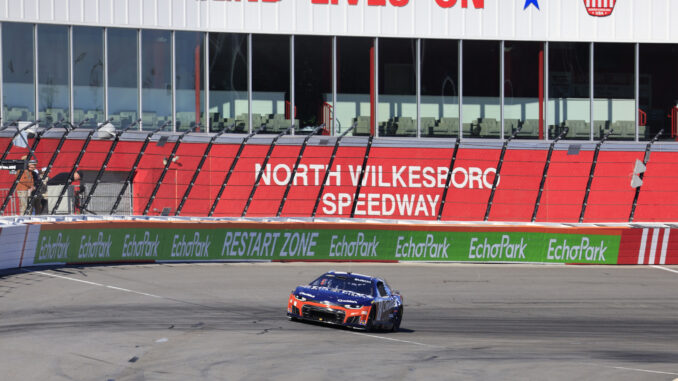
The quiet of a NASCAR winter has a very specific sound. It’s the absence of engines, the low buzz of rumor, the polite fiction that everyone is resting. On Tuesday at North Wilkesboro Speedway, that silence finally cracked.
Fifteen Cup Series teams rolled onto the 0.625-mile oval tucked into the Brushy Mountains and did something NASCAR people never pretend not to enjoy: they fired the cars and went racing, if only unofficially. No points were paid. No trophies were handed out. But for the first time in 2026, the Cup Series was back on track, and it sounded like it meant it.
The one-day organizational test marked the series’ first collective laps of the new season and came with an important change bolted firmly under the hood. NASCAR’s long-discussed horsepower increase is no longer theoretical. Tuesday’s baseline sat at 750 horsepower, up from the 670 number teams have lived with on short tracks and road courses in recent years. And almost immediately, the response leaned positive.
“The more horsepower, the better, yes,” Ricky Stenhouse Jr. said, summing up a sentiment shared quietly—and sometimes not so quietly—throughout the garage. He pointed to Goodyear’s continued progress with tire wear as part of the bigger picture, noting that drivers and teams appear aligned on the direction NASCAR is heading. More power, tires that fall off, and races that ask a little more of everyone involved.
That, in theory, is the goal.
In practice, Tuesday was about information. NASCAR competition officials cycled teams through a range of setup configurations to better understand how the Next Gen car behaves on short tracks with the added horsepower. Rear suspension and camber adjustments were tested. A softer tire compound was evaluated. Minor aerodynamic tweaks were layered in, sometimes individually and sometimes together, all in an effort to fine-tune the balance.
Originally scheduled from 9 a.m. to 5 p.m. ET, the test day quietly expanded. Officials extended on-track time by two hours into the evening, squeezing as much data as possible out of a rare opportunity. No one seemed eager to pack up early.
Conditions, however, came with an asterisk. Winter temperatures warmed slightly under the afternoon sun, but the grip level was far higher than what teams expect when the Cup Series returns in midsummer. Cooler air and a quiet track masked some of the challenges that will inevitably appear in July.
Chase Elliott acknowledged as much, noting that the horsepower increase isn’t likely to hurt the racing—and may ultimately help it—once the environment changes.
“I don’t see the power hurting the entertainment factor of the race,” Elliott said. He pointed out that even in the cool conditions, there was noticeable fall-off by the end of longer runs. Add summer heat, more cars, and a busier racetrack, and the equation changes quickly. Elliott also credited Goodyear’s tire developments from last season as a meaningful step forward, suggesting the sport is gradually inching toward races that demand more management over long green-flag runs.
Tuesday’s test wasn’t just about rules packages and data traces, either. It doubled as a rare chance for new driver, crew chief, and team combinations to exist together in the real world. Four of the 15 teams used the day to begin sorting through fresh pairings, including Kyle Busch with new crew chief Jim Pohlman at Richard Childress Racing, Erik Jones and Justin Alexander at Legacy Motor Club, Ross Chastain with Brandon McSwain at Trackhouse, and Daniel Suárez beginning his tenure at Spire Motorsports with crew chief Ryan Sparks.
For Suárez, the day carried extra importance. He arrived with a familiar voice in his ear—spotter Frankie Kimmel—but nearly everything else was new. New team. New surroundings. New reference points.
“It’s been super-productive for us,” Suárez said, explaining that the test was as much about communication as it was speed. What looks fine in the shop can feel very different once the car is on track, and by the end of the day, Suárez already had a working list of items to address when the team returns home. Just as important, he said, was establishing a rhythm with the people around him.
The setting itself mattered, too. North Wilkesboro has hosted the All-Star Race since its return, but July’s Window World 450 will mark the track’s first points-paying Cup event since 1996. For a sport that rarely circles back, that’s still a notable milestone.
Officially, Tuesday was a test. In reality, it was something else. It was the first audible reminder that the season is approaching, that winter doesn’t last forever, and that NASCAR doesn’t stay quiet for long. And here in January 2026, with engines echoing through the hills of North Carolina, the offseason already feels shorter than it did a week ago.

Greg was a writer for DriveTribe supporting Amazon's The Grand Tour and has been published in major publications across the country including the Los Angeles Times, the Cleveland Plain Dealer and the Atlanta Journal-Constitution. He was also a contributor to Chicken Soup for the NASCAR Soul, published in 2010, and the Christmas edition in 2016. He wrote as the NASCAR, Formula 1, Auto Reviews and National Veterans Affairs Examiner for Examiner.com and has appeared on Fox News. He holds a BS degree in communications, and a Masters degree in psychology. He is currently the weekend Motorsports Editor for Autoweek and a regular contributor to Forbes.
- Martinsville Crash Highlights Bubba Wallace’s Frustrating Sunday - March 29, 2026
- Denny Hamlin’s Perfect Day Ends in Perfect Frustration - March 29, 2026
- Chase Elliott Short Pits his Way Past 292 Laps of Dominance - March 29, 2026