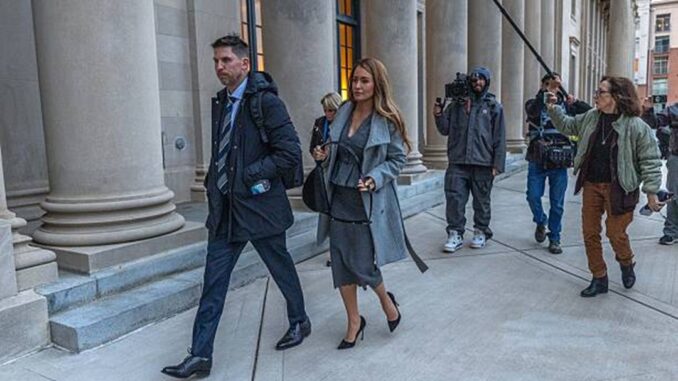
CHARLOTTE, N.C.—After strong opening arguments by attorneys for both sides in the 23XI Racing and Front Row Motorsports v. NASCAR antitrust case, the first day of trial ended with 23XI co-owner Denny Hamlin on the stand.
Under direct examination in Judge Kenneth D. Bell’s courtroom from Jeanifer Parsigian, one of plaintiffs’ attorneys from Winston & Strawn, Hamlin on Monday had barely begun to touch on the substantive issues of the case before the trial in the Western District of North Carolina Courthouse adjourned at 5 p.m.
Hamlin testified, for example, that 23XI Racing had paid $4.7 million, $13.5 million and $28 million for a succession of three NASCAR Cup Series charters as the race team he co-founded with former NBA superstar Michael Jordan grew from a business proposition to a three-car organization with a $35-million headquarters in Huntersville, N.C.
Those were the same figures cited in opening statements by John Stephenson of Alston & Bird, one of three firms representing NASCAR and chairman and CEO Jim France in the litigation.
The charter system, instituted by NASCAR in 2016 at the request of Cup Series teams, resides at the core of the case. When charters came up for renewal in 2025, 23XI and Front Row (owned by Bob Jenkins) declined to sign, whereas the 13 other chartered Cup teams opted to do so.
Plaintiffs’ lead attorney Jeffrey L. Kessler contended in his opening statement that NASCAR, as a monopsony in the highest level of stock car racing (in other words, as the only buyer of services in that realm) had used its power to depress prices paid to race teams and that teams were hurt by the exercise of that power.
Stephenson countered that the original charter agreement had conferred benefits to Cup teams that did not exist previously: guaranteed starting spots for all 36 chartered cars, additional money paid to the holders of charters and an asset (the charter itself) given to charter agreement signees in 2016 that has steadily increased in value, with reported sales of up to $45 million.
“NASCAR paid every cent that was due to the teams for nine years,” Stephenson said. “You won’t hear that NASCAR broke its word to the teams under the charter agreement.”
Kessler contended that NASCAR’s ownership of Cup Series race tracks and exclusivity agreements with other venues, particularly those owned by Speedway Motorsports, Inc., prevented race teams from achieving fair market value for their services.
Stephenson pointed out that the Department of Justice’s Antitrust Division had reviewed NASCAR’s acquisition of International Speedway Corporation (and its portfolio of race tracks), which closed for $2 billion in 2019.
Stephenson also contended that none of the anticompetitive issues alleged in the complaint—whether race tracks, the Gen-7 race cars and associated intellectual property restrictions or the charter system itself—had not been raised in the two-and-a-half years of charter negotiations nor in an eight-point letter sent by 23XI to NASCAR before 23XI and Front Row filed suit.
“This is not a case about anti-competitive conduct at all,” Stephenson asserted.
In his testimony, Hamlin estimated that the average cost to put a race car on the track for one year is $20 million. He stated further that each charter paid an average of $12.5 million to respective race teams in 2025 versus approximately $9 million under the previous charter agreement.
Hamlin, who recounted the financial support from his parents early in his racing career, cited the need for teams to have a voice in NASCAR-mandated expenditures as one reason for not signing the 2025 charter agreement.
“Schedule, car changes, rule changes—all those things directly affect our bottom line,” said Hamlin, who will return to the stand on Tuesday for continued direct testimony and cross-examination.
As an example, Hamlin cited the Cup Series race in Mexico City as burdensome in terms of overtime to employees and complicated logistics.
Jury selection on Monday morning went relatively quickly and with just one snafu. One of the jurors chosen subsequently was released for necessary family obligations and replaced in short order. The jury that will determine the facts of the case consists of six men and three women.
Bell repeatedly admonished the jurors not to discuss the case with any outside parties.