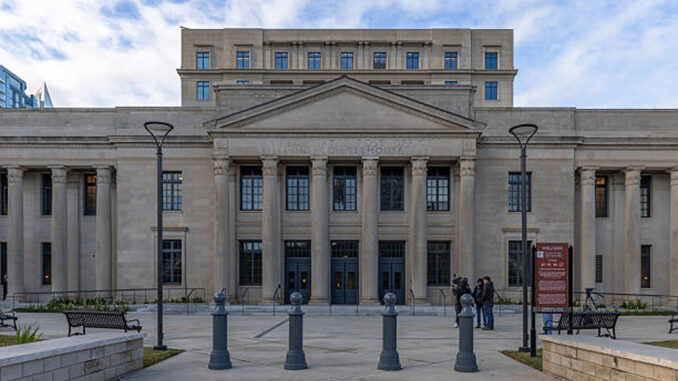
CHARLOTTE, N.C.—In the Western District of North Carolina courthouse on Monday, participants and onlookers in Judge Kenneth D. Bell’s courtroom spent most of the afternoon in “but for” world.
Economist Edward A. Snyder, an expert witness for the plaintiffs in the “23XI Racing and Front Row Motorsports v. NASCAR” antitrust litigation, spent hours on the stand first presenting and then defending his thesis that anti-competitive practices on the part of NASCAR damaged 23XI and Front Row during the period 2021 through 2024.
Plaintiffs used Snyder to try to establish the amount of monetary damages the two race teams have suffered under the 2016 charter agreement during that four-year period. NASCAR’s alleged anti-competitive behavior and the amount of damages, if any, are matters in dispute in the trial.
Snyder contended that 23XI and Front Row both would have made more money and that their organizations would have been worth much more, but for NASCAR’s alleged anti-competitive actions.
Citing issues that have become familiar themes during the proceedings, Snyder pointed to the goodwill or non-compete provisions of the charter agreements with NASCAR Cup Series race teams, the exclusivity clauses in sanctioning agreements with race tracks and the intellectual property restrictions placed on NASCAR’s Gen-7 race cars, which were introduced into the Cup series in 2022.
Snyder based his analysis on the supposition that a competing premier stock car racing series would have been viable by 2021 in “but for” world—had the above provisions not existed.
On cross-examination, however, NASCAR outside counsel Lawrence F. Buterman brought out the fact that no equivalent series had ever come into being in NASCAR’s 77-year history. That was true even before 2016 charter agreements were adopted by Cup Series teams, during a lengthy period when no such restrictions existed.
Using Formula 1 racing as the closest benchmark to NASCAR, and incorporating a multiple of 4.3 times annual earnings, Snyder postulated that 23XI would have made an additional $41 million and Front Row and additional $43 million over the four years in question.
Added to that were Snyder’s calculations of reduction in market values of $163.8 million for 23XI and $96.4 million for Front Row, based on the 4.3 multiplier.
Buterman questioned Snyder of the presumption that NASCAR would have paid its chartered teams an additional $1.06 billion had a rival league actually existed, a figure that was a fundamental part of the calculations.
“I don’t know how NASCAR’s going to respond (to competition),” Snyder acknowledged.
Snyder’s estimates of potential profits and market value also were dependent on raising the share of NASCAR revenues paid to teams from 25 percent (as under the 2016 charter agreement) to 45 percent (the rate Snyder incorporated from F1).
According to the plaintiffs’ own chart, as Buterman pointed out, the amount of revenue F1 paid to its teams in 2023 and 2024 was 37 percent.
Snyder also acknowledged under cross that his estimates did not take into consideration any potential decrease in NASCAR revenues based on competition from a rival series.
Buterman also challenged Snyder’s contention that NASCAR “paid for exclusivity” in its contracts with Cup race tracks. In fact, evidence submitted during trial indicates that NASCAR paid 65 percent of broadcast rights revenue to the tracks before and after exclusivity provisions were added to the sanctioning agreements concurrent with the adoption of the charter system in 2016.
Snyder’s testimony followed the completion of the cross-examination of Race Team Alliance executive director John Marshall, who acknowledged that no other racing series had provided permanent charters to its teams (a prevalent issue in the trial).
Marshall also testified that, after an initial request of an aggregate $720 million annually during 2025 charter negotiations, the majority of NASCAR team owners reacted positively to an offer from NASCAR between $410 million and $451 million in the new 2025 charter agreement, based on a fixed 45 percent of broadcast revenue.
In fact, 13 of the 15 teams signed the 2025 charter agreement. Only 23XI and Front Row did not.
The trial will continue on Tuesday morning with Snyder on the stand. The plaintiffs are expected to call NASCAR commissioner Steve Phelps, Cup Series team owner Richard Childress and NASCAR chairman and CEO Jim France as their next witnesses.