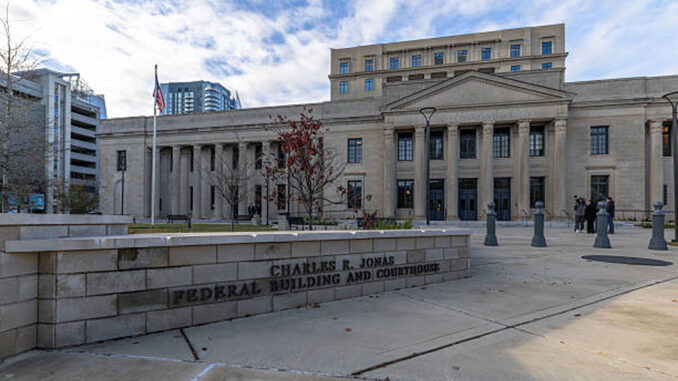
CHARLOTTE, N.C.—In late morning of the fourth day of the “23XI Racing and Front Row Motorsports v. NASCAR” antitrust trial, NASCAR president Steve O’Donnell took the stand as an adverse witness called by plaintiffs’ lead attorney Jeffrey Kessler.
What soon became abundantly clear on Thursday at the Western District of North Carolina courthouse were the points of emphasis Kessler would use to try to establish anti-competitive behavior on the part of NASCAR toward its chartered race teams.
Kessler asked O’Donnell repeatedly about the exclusivity provisions in NASCAR’s sanctioning agreements with race tracks, most prominently properties owned by Speedway Motorsports.
Other significant issues included the potential threat to NASCAR of competing racing series—notably SRX; the lack of permanence of the charters under the 2025 agreement; and governance of the sport, given the specific exclusion of the so-called “three strikes” provision in the current charter agreement.
To that last point, O’Donnell testified, NASCAR wanted to eliminate team owners’ veto power over cost increases in order to grow the sport.
With the three-strikes provision (owners with voting power) in place, O’Donnell said, “We would not have been in Mexico City (in 2025), and the TV partner (Amazon Prime Video) would not have paid the money they did.”
Similarly, three years of races on the Chicago Street Course—initially a hard sell to the NASCAR board headed by chairman and CEO Jim France—cost NASCAR an estimated $55 million, but the enterprise served a broader purpose.
“Amazon said there was no way they would have engaged with our sport without that,” O’Donnell told NASCAR outside counsel Chris Yates after Kessler finished his questioning. “It was a long shot, but we were able to pull it off, and it was a successful event.”
O’Donnell explained that the sanction agreements with Speedway Motorsports were expanded from a single year to five years in 2016 to coincide with the initial term of the charter agreements, which changed the economic paradigm of the sport.
The exclusivity provisions in the sanctions were expanded starting in 2016, as NASCAR strove to establish a predictable revenue model that would function under the charter agreements with the race teams.
In his initial questioning, Kessler asked O’Donnell about a litany of contingency plans NASCAR had considered, if race teams opted not to sign the 2025 charter agreement.
Kessler pointed to SRX as a potential competitor to NASCAR, and O’Donnell acknowledged the sanctioning body had become more concerned with the new series as it evolved in a direction more closely resembling a NASCAR product.
However, both NASCAR drivers and team owners (23XI principal Denny Hamlin, Brad Keselowski, Chase Elliott and Justin Marks) drove in SRX races, which took place exclusively on short tracks.
O’Donnell also pointed out that SRX was owned by Tony Stewart, who simultaneously held NASCAR Cup Series charters as co-owner of Stewart-Haas Racing.
O’Donnell’s testimony, which will conclude Friday, followed the completion of the cross-examination and redirect of Front Row Motorsports owner Bob Jenkins, one of the plaintiffs in the case.
Earlier in the morning, concluding his testimony, Front Row Motorsports (FRM) owner Bob Jenkins admitted he incorrectly stated Wednesday that it costs FRM $20 million per season to a run a single car in the NASCAR Cup Series. The Defense cited FRM’s own financial records, which showed that the most it has spent in a year on running two Cup Series car was around $28 million ($14 million per car).
At the close of the court session on Thursday, Judge Kenneth D. Bell expressed displeasure with the pace of the trial and urged attorneys from both sides to use discipline in the questioning of witnesses.
As a parting shot, Bell added that some of the questioning involved “beating the horses well beyond their deathbeds.”
The pace of the trial may affect the appearance of team owner Roger Penske as a witness for NASCAR. Yates said Penske’s only available day is Monday, and the plaintiffs have not agreed to let him testify before they have rested their case.