
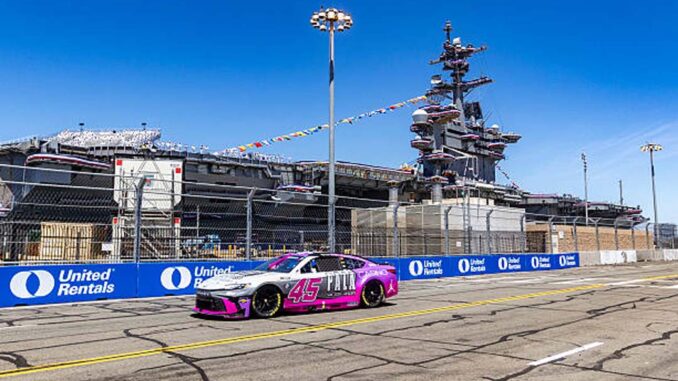
NASCAR has apparently decided that racing around an active military installation in Southern California wasn’t quite crazy enough the first time.
So it’s doing it again.
NASCAR will return to Naval Base Coronado in San Diego on Aug. 1, 2027, bringing the Cup Series back to the 16-turn, 3.4-mile circuit for a second consecutive season and, perhaps more importantly, giving us the first real glimpse of a much bigger plan for NASCAR’s future.
Because San Diego isn’t supposed to be the end of this experiment.
It’s the beginning.
The 2027 race will be the second consecutive Cup Series visit to Naval Base Coronado after the inaugural event in 2026 turned a military installation into one of the most unusual race tracks NASCAR has ever visited. The circuit winds through the active base with downtown San Diego and, this past year at least, the USS Carl Vinson providing a backdrop that makes the average NASCAR weekend look like it needs to try harder.
And NASCAR apparently agrees.
Chief Operating Officer Ben Kennedy said the success of the inaugural event helped spark discussions about taking the concept to other military installations beginning in 2028.
“We agreed in 2028 we’re going to go to another military installation as a part of a long-term plan,” Kennedy said.
That means NASCAR isn’t simply returning to San Diego because the first race worked. It’s using San Diego as a blueprint.
And that’s considerably more interesting.
The idea is to rotate the military-base race to different installations and potentially different branches of the military, allowing NASCAR to take its circus — and yes, it is still a circus, just one with considerably more disciplined parking attendants — to parts of the country where it doesn’t currently have much of a presence.
Kennedy said NASCAR officials are already looking at potential markets, including military installations that are recognizable well beyond their immediate communities.
“We’ve been digging into a number of different markets that we feel like are priority markets for us to be in that we frankly don’t have a large presence in today,” Kennedy said, along with “iconic installations that everyone knows of.”
Exactly where NASCAR goes in 2028 remains undecided. But the important part is that there is now a plan.
And that plan was helped along by what happened in San Diego this year.
The inaugural event was deemed a tremendous success by NASCAR, with Kennedy saying after the race that the organization would love to return. The event also provided something NASCAR increasingly values: a race weekend that feels like it could not simply be picked up, dropped into another city and recreated.
That’s a big deal in an era when street races are multiplying and NASCAR is looking for ways to create events rather than simply schedule races.
San Diego has an active naval base, an aircraft carrier sitting nearby, spectacular views, a temporary circuit and the sort of setting that makes television producers start rubbing their hands together.
It also produced pretty good racing.
Corey Heim won the inaugural Cup Series race in just his 13th start before going on to win the Brickyard 400. Austin Hill won the O’Reilly Auto Parts Series race, while Layne Riggs won the Craftsman Truck Series event in overtime.
The Truck Series won’t return to San Diego in 2027, however. It will instead make its September visit to Canadian Tire Motorsport Park.
The Cup and O’Reilly Series will return to Coronado, with the O’Reilly race scheduled for Saturday July 31 and the Cup race the following day Aug. 1.
NASCAR also isn’t pretending it got everything right the first time.
Kennedy said the organizers spent a day and a half at an off-site retreat in Charlotte going over what worked, what didn’t and what could be improved. NASCAR gathered feedback, studied data and went through what Kennedy described as “a lot of learnings.”
The track itself isn’t expected to change much.
The fan experience is.
NASCAR plans to focus on ingress and egress, concession areas, seating viewpoints and the overall ability for fans to actually see what they’ve paid to see. Which, despite being an alarmingly basic concept for a sporting event, is occasionally something that needs fixing after the first lap.
The idea is bigger than San Diego, too.
If NASCAR is serious about taking temporary circuits to military installations around the country, it needs a playbook. San Diego provides one.
“Fans will expect some changes to the experience,” Kennedy said. “The course, for the most part, is going to stay intact, so we don’t expect any big changes related to that, but really focused on ingress, egress, concession stands, the viewpoints and perspectives for a lot of our fans.”
That’s the sort of boring operational stuff that doesn’t make headlines but can determine whether an event becomes an annual success or a very expensive lesson.
There will also be a Navy Community Night on July 30, giving sailors and Coronado community members access to the base for O’Reilly Series practice and qualifying and other activities.
The Cup race will also serve as the championship round of the 2027 NASCAR In-Season Challenge, the third edition of the five-race, 32-driver midseason tournament.
And while the San Diego announcement is the headline, it’s also another piece of a 2027 NASCAR schedule that is beginning to look surprisingly real.
The Daytona 500 remains the season opener on Feb. 21, followed by a schedule that includes visits to EchoPark Speedway, Circuit of The Americas, Phoenix, Las Vegas, Darlington, Bristol, Martinsville, Talladega, Texas, Kansas and Dover before the All-Star Race returns to North Wilkesboro.
The summer will include Pocono, the return of Chicagoland Speedway, Iowa and a second stop at EchoPark before the series heads west to Coronado.
The playoff portion of the schedule is also beginning to take shape, with Bristol, World Wide Technology Raceway, Daytona, Darlington, Richmond, Watkins Glen, New Hampshire, Kansas, Las Vegas, Phoenix, Talladega, Martinsville and Homestead-Miami among the venues currently listed.
There are still dates and details to be finalized, but the skeleton is there.
And sitting right in the middle of it is a race track that shouldn’t exist.
Which, frankly, is becoming one of NASCAR’s favorite ways to do business.
San Diego isn’t just getting another NASCAR race in 2027. It is becoming the test case for whether NASCAR can take the sport to places where nobody ever thought a stock car race belonged — and then make people wonder why it took so long to get there.
And that’s where this gets really interesting.
NASCAR plans to return to Naval Base Coronado in 2027, but the long-term strategy calls for the military-base race to move to a different installation in 2028. So San Diego isn’t necessarily becoming a permanent stop on the schedule.
It’s becoming the first stop on a traveling military-base tour.
And if NASCAR can make that work, there could be a whole lot more very strange — and very spectacular — places for stock cars to go racing.

Greg was a writer for DriveTribe supporting Amazon's The Grand Tour and has been published in major publications across the country including the Los Angeles Times, the Cleveland Plain Dealer and the Atlanta Journal-Constitution. He was also a contributor to Chicken Soup for the NASCAR Soul, published in 2010, and the Christmas edition in 2016. He wrote as the NASCAR, Formula 1, Auto Reviews and National Veterans Affairs Examiner for Examiner.com and has appeared on Fox News. He holds a BS degree in communications, and a Masters degree in psychology. He is currently the weekend Motorsports Editor for Autoweek and a regular contributor to Forbes.
- Kyle Larson turns Talladega chaos into championship gold - October 25, 2026
- Joey Logano gets a little more Talladega Nights than he bargained for - October 25, 2026
- Ryan Blaney’s title hopes are on life support after Big One at Talladega - October 25, 2026