
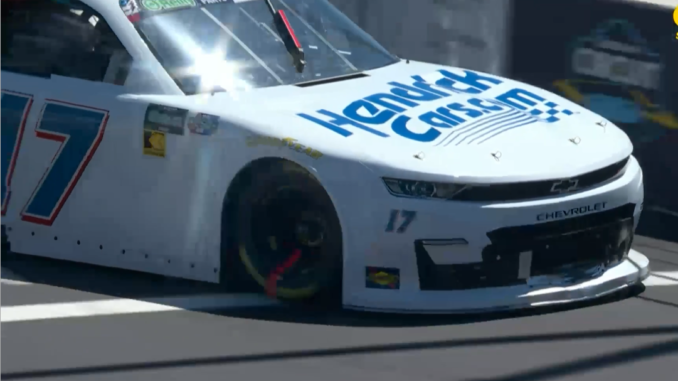
For Corey Day, Saturday’s O’Reilly Auto Parts Series race at San Diego Street Course was supposed to be a recovery mission.
Instead, it became a lesson in why motorsports and municipal infrastructure should probably maintain a respectful distance.
Day had already been dealt a lousy hand before the green flag ever dropped. After slapping the wall in Friday qualifying, the No. 17 Hendrick Motorsports team rolled out a backup car and sent him to the rear of the field.
Then, on the opening lap, the race found an entirely new and deeply creative way to ruin his afternoon.
Somewhere along the 3.4-mile temporary street circuit laid across active Naval Base Coronado, a utility cover that had endured two days of race traffic decided it had simply had enough. It shook loose, launched upward and, through a combination of rotten luck and physics that deserve further investigation, flew directly into the center of Day’s grille.
Game over.
“We have a manhole cover sitting in our radiator,” crew chief Adam Wall radioed to Day. “It blew the radiator and oil cover right through it. We have to go behind the wall. Unfortunately, that’s something we can’t fix, even though it’s their fuck up.”
To call it bad luck almost undersells the absurdity of it. This wasn’t debris kicked up in a pack or contact from another driver. This was a utility cover, roughly half the size of a traditional manhole lid, turning itself into a guided missile and punching straight through the nose of Day’s Chevrolet.
Because the damage was caused by the track itself, NASCAR granted the No. 17 team an exception to its standard rule requiring teams to use the same radiator throughout an event and Day’s crew was cleared to replace the damaged components in the open work area.
After five laps under caution, NASCAR had seen enough and threw the red flag to allow crews to re-weld the utility cover back into place.
Then came the sentence nobody organizing a street race wants to hear.
During the stoppage, officials swept the entire circuit looking for additional trouble spots and discovered another loose utility cover in Turn 6, which was also rewelded. NASCAR Vice President of Racing Communications Mike Ford confirmed the second repair on social media.
Meanwhile, Day’s crew attacked the repairs with the urgency of people trying to rebuild a race car after losing an argument with public works.
They got it done before the race resumed.
Initially, NASCAR scored Day with only one completed lap, which would have dropped him four laps behind the field. But after reconsideration, officials reversed course and allowed Day to run alone under caution to make up the deficit while accumulating comparable tire wear.
It was a rare moment of balance from the racing gods.
Naturally, that balance lasted about five minutes.
Day ducked to pit road shortly before the end of Stage 1 and was immediately tagged for speeding, because apparently being attacked by the racetrack itself wasn’t considered sufficient suffering for one afternoon.
And if Day felt like asking what cosmic debt he was repaying, you could hardly blame him. Just one week earlier at Pocono, his day ended before it ever really started after getting collected in an opening-lap crash.
Most drivers spend June worrying about tire falloff and fuel windows.
Corey Day appears to be conducting independent research into all the different ways a race can end before lunch.

Greg was a writer for DriveTribe supporting Amazon's The Grand Tour and has been published in major publications across the country including the Los Angeles Times, the Cleveland Plain Dealer and the Atlanta Journal-Constitution. He was also a contributor to Chicken Soup for the NASCAR Soul, published in 2010, and the Christmas edition in 2016. He wrote as the NASCAR, Formula 1, Auto Reviews and National Veterans Affairs Examiner for Examiner.com and has appeared on Fox News. He holds a BS degree in communications, and a Masters degree in psychology. He is currently the weekend Motorsports Editor for Autoweek and a regular contributor to Forbes.
- NASCAR’s old Chase format is making the championship fun again - October 19, 2026
- Denny Hamlin’s Phoenix escape plan gets a speeding ticket - October 18, 2026
- Kyle Larson’s tire wasn’t the only thing to go flat at Phoenix - October 18, 2026