
NASCAR spent the last month or so rummaging through its rulebook like a homeowner finally cleaning out the junk drawer and Friday announced some changes. Some things were tossed. Some things were rearranged. And a few things were added that make you wonder how they weren’t obvious earlier.
Start with the Xfinity Fastest Lap award in the Cup Series, which had quietly drifted from “neat performance bonus” into “unintended comedy sketch.” Last season featured multiple occasions where a car that had already been bent, broken, and cosmetically reassembled in the garage returned to the track, ran one clean lap on fresh tires, and walked off with a bonus point like it had just done something heroic.
NASCAR has now decided that this might be missing the spirit of the thing.
Going forward, once a Cup car has been repaired in the garage, it is no longer eligible to earn the Fastest Lap bonus. The lap time still counts. The stopwatch still works. You just don’t get a gold star and a point for showing up late with a freshly glued-together racecar and briefly embarrassing the field. This is less a crackdown and more NASCAR politely clearing its throat and saying, “Let’s not do that again.”
Elsewhere in the rulebook, NASCAR has softened its stance on loose lug nuts, which in recent years had escalated into penalties that felt less like officiating and more like a medieval justice system.
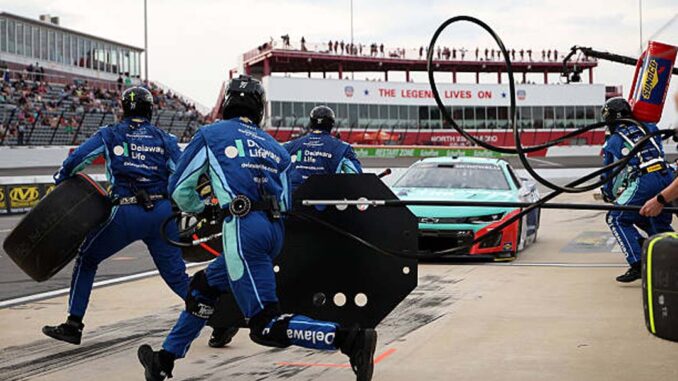
Under the revised policy for the O’Reilly Auto Parts Series and the Craftsman Truck Series, penalties are now tiered with a bit more restraint. If 19 of 20 lug nuts are confirmed safe and secure, the punishment is the loss of pit selection for the next race. Annoying, but survivable.
At 18 secure lug nuts, the hammer comes down harder: a fine and a one-race suspension for a crew member. The fine is $5,000 in the O’Reilly Auto Parts Series and $2,500 in Trucks. And if four lug nuts are missing, that’s now an automatic disqualification in both series. Game over.
This replaces a system where penalties started at one missing lug nut and could snowball into crew chief suspensions, a structure teams argued was wildly disproportionate to the actual offense. NASCAR, after listening to those complaints, has agreed—at least partially—that not every mistake needs to be punished like a felony.
There’s also some quiet manufacturer-related housekeeping as Ram prepares to re-enter the NASCAR landscape.
For the opening three Craftsman Truck Series races—Daytona, EchoPark Speedway, and the St. Petersburg street race—NASCAR will reserve up to four additional OEM provisional spots. If a Ram-backed truck fails to qualify on speed, it can still be added to the field, starting at the rear. Should all four spots be needed, the field could expand from 36 to 40 trucks.
This is less about favoritism and more about reality management. NASCAR wants new manufacturers. New manufacturers want guarantees that showing up won’t result in loading back onto the hauler before the green flag. Everyone pretends this is temporary and strictly controlled, which it probably is—at least until the next new badge shows interest.
Finally, NASCAR adjusted its age requirements in the O’Reilly Auto Parts Series, lowering the minimum age to 17 on tracks 1.25 miles and shorter. That neatly slots the series between Trucks, which allow 16-year-olds, and Cup, which remains at 18.
It’s a small change, but a meaningful one, smoothing the ladder system and acknowledging that the path upward doesn’t need quite so many artificial speed bumps.
None of these changes will dominate headlines. None will transform the sport overnight. But taken together, they suggest NASCAR is paying closer attention to how its rules function in the real world—and occasionally admitting that some of them were a bit silly to begin with.

Greg was a writer for DriveTribe supporting Amazon's The Grand Tour and has been published in major publications across the country including the Los Angeles Times, the Cleveland Plain Dealer and the Atlanta Journal-Constitution. He was also a contributor to Chicken Soup for the NASCAR Soul, published in 2010, and the Christmas edition in 2016. He wrote as the NASCAR, Formula 1, Auto Reviews and National Veterans Affairs Examiner for Examiner.com and has appeared on Fox News. He holds a BS degree in communications, and a Masters degree in psychology. He is currently the weekend Motorsports Editor for Autoweek and a regular contributor to Forbes.
- NASCAR’s 2027 schedule is a greatest hits album with new songs - August 26, 2026
- NASCAR doubles down on San Diego as military-base racing gets bigger - August 25, 2026
- Bubba Wallace was one lockup away from stealing Ryan Blaney’s lobster - August 23, 2026