
After more than a decade of explaining NASCAR’s championship format with the help of charts, flow diagrams, interpretive dance, and at least one sacrificial goat, the sport has finally done something radical.
It simplified.
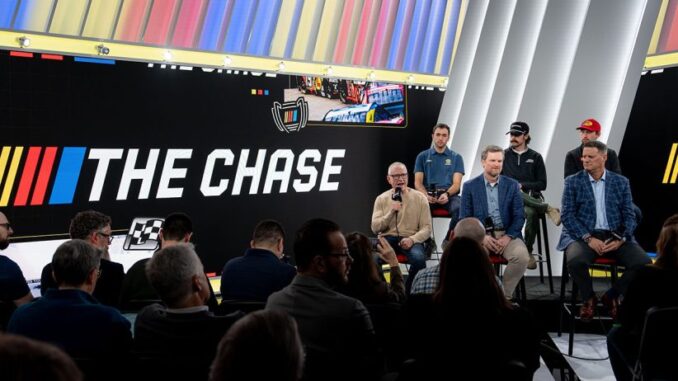
On Monday afternoon, inside the NASCAR Productions Facility, officials announced that the elimination-style playoff era is officially over. Dead. Gone. Packed up and shipped out with the rest of the ideas that sounded clever in a conference room but aged like milk left out in the Florida sun.
In its place, NASCAR is bringing back The Chase in all three national series beginning in 2026, ending the winner-take-all finale and restoring a postseason that rewards something fans have been loudly demanding for years: not being punished for being good all season.
Yes, really.
This marks the end of the system that crowned champions based on one race, one restart, or one poorly timed sneeze. Since 2014 in the Cup Series — and 2016 in Xfinity and Trucks — NASCAR has lived in a world where a year’s worth of excellence could be undone in three hours. Now, the sport is rewinding the tape, borrowing from its own history, and admitting that maybe, just maybe, consistency should matter again.
Steve O’Donnell, NASCAR’s president, said the shift came from a hard look at who the sport wants to be moving forward — and who stuck around when things got weird.
“The biggest thing was looking at who we wanted to be as a sport going forward,” O’Donnell said, pointing directly at the core fan base that has endured every format tweak, reset, bonus point, and rule explanation since 2004. The message was simple: the championship should reflect what those fans value.
And those fans, bless them, value something called “knowing what’s going on”.
The new Chase format mirrors the 2004–2013 system, but with updates meant to reflect modern NASCAR rather than pretending it’s still 2007 and everyone has a flip phone.
The fields remain the same — 16 drivers in Cup, 12 in Xfinity, 10 in Trucks — but qualification is now purely based on regular-season points. The “win-and-you’re-in” rule has been sent to the same place as stage cautions every ten laps. Winning still matters, but it no longer serves as a get-out-of-jail-free card for a mediocre season.
Race winners now earn 55 points, a 15-point bump designed to make Victory Lane feel meaningful again without turning the rest of the calendar into filler. Playoff points are gone entirely. No hoarding bonuses. No banking advantages. When the Chase begins, everyone resets, with only a modest 25-point premium awarded to the regular-season champion.
From there, it’s brutally straightforward. Ten races in Cup and the O’Reilly series, seven in Trucks. One points system. No eliminations. No manufactured drama. The driver with the most points at the end is the champion. Full stop.
If that sounds refreshingly obvious, that’s because it is.
According to O’Donnell, the committee explored every possible alternative — tweaking eliminations, expanding finals, scrapping playoffs entirely — before landing on what he called a “happy medium.” The goal wasn’t to please everyone. It was to stop confusing everyone.
And let’s be honest: last year didn’t help the old system’s case.
Phoenix Raceway once again became the center of uncomfortable conversations after season-long standouts Denny Hamlin and Connor Zilisch walked away empty-handed, while Truck Series champion Corey Heim needed a last-ditch overtime move to save his title. Dramatic? Absolutely. Sustainable as a championship philosophy? Not so much.
Even O’Donnell admitted the spectacle was thrilling — but also revealing.
“It just felt like the industry and everyone was really ready for us to make it as simple as possible,” he said. And that word — simple — kept coming up again and again.
The committee’s litmus test was famously blunt: could you explain the championship format during a short elevator ride without losing the other person halfway through? Under the old system, the answer was “no,” unless that elevator was stuck for several hours.
Under the new Chase, the explanation fits comfortably between floors.
The change to a 55-point race win also addresses one of the unintended consequences of win-and-you’re-in: distorted behavior. While NASCAR doesn’t want to eliminate aggression entirely — this is still stock car racing, after all — it also doesn’t want drivers treating entire races as expendable once a box has been checked.
More points for winning, O’Donnell said, keeps the incentive alive without turning the rest of the season into a waiting room.
The Chase will officially return in September, beginning at Darlington on Labor Day weekend for both Cup and O’Reilly, with Trucks following at Bristol. NASCAR hopes to align those schedules even more closely in the future, because consistency, it turns out, is having a moment.
The format itself may feel like a step backward to some, but NASCAR is betting it’s actually a step toward sanity. The sport didn’t abandon innovation. It abandoned overcomplication.
And for the first time in a long while, fans might not need a rulebook, a calculator, and a support group to figure out who’s winning the championship.
Which feels like progress.

Greg was a writer for DriveTribe supporting Amazon's The Grand Tour and has been published in major publications across the country including the Los Angeles Times, the Cleveland Plain Dealer and the Atlanta Journal-Constitution. He was also a contributor to Chicken Soup for the NASCAR Soul, published in 2010, and the Christmas edition in 2016. He wrote as the NASCAR, Formula 1, Auto Reviews and National Veterans Affairs Examiner for Examiner.com and has appeared on Fox News. He holds a BS degree in communications, and a Masters degree in psychology. He is currently the weekend Motorsports Editor for Autoweek and a regular contributor to Forbes.
- Hamlin’s nine-point Chase lead is becoming a very bad joke - September 13, 2026
- Kyle Larson outlasts flying cars, exploding brakes and Joey Logano in St. Louis - September 13, 2026
- Ryan Blaney’s championship charge takes a very hard right turn - September 13, 2026