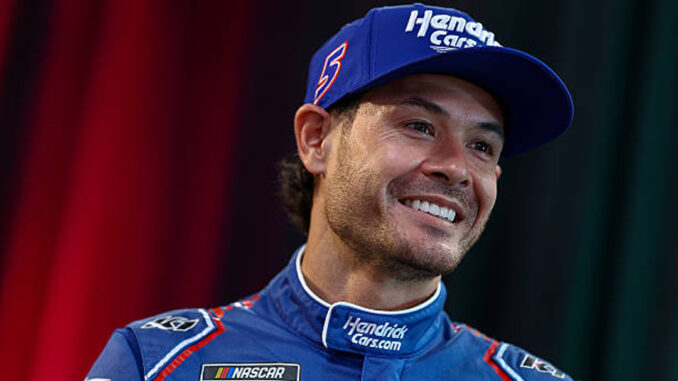
The 2026 NASCAR Cup Series championship fight was over before the race had really gotten started. And Kyle Larson found out in a manner that was about as exciting as receiving a notification that your electricity bill is due.
With fewer than 10 laps remaining in Stage One of Sunday’s season finale at Homestead-Miami Speedway, the engine in polesitter Chase Briscoe’s Toyota decided it had endured quite enough of the 2026 season. It let go in spectacular fashion, leaving a trail of smoke along the frontstretch and bringing out the caution.
The timing couldn’t have been better for Larson.
Tyler Reddick was leading when the stage ended, with Larson running fourth. Just a couple of laps earlier, Larson had passed championship rival Denny Hamlin and was working on another title contender, Christopher Bell, for third when Briscoe’s mechanical failure interrupted the proceedings.
That fourth-place stage finish was enough. NASCAR officially declared Larson the 2026 Cup Series champion, ending the championship battle with 188 laps still remaining in the race.
“Uh, they’ve declared it,” crew chief Cliff Daniels informed Larson over the team radio.
“Like it’s done?” Larson asked.
“We’ve got it,” Daniels replied.
“OK. That was a little anticlimactic,” Larson said.
Understatement of the afternoon.
But while the championship announcement might have arrived with all the drama of a printer running out of paper, Larson’s road to a third Cup title was anything but straightforward.
NASCAR brought back The Chase in 2026, featuring a single points reset after the regular season, a 16-driver field and 10 races without eliminations. Wins were worth 55 points, but stage points and avoiding disastrous afternoons were just as important.
Larson turned out to be exceptionally good at all of it. He just needed most of the regular season to remember how.
Winless through the opening 26 races, Larson carried a 51-race victory drought into September. Meanwhile, Hamlin entered The Chase as the top seed, 55 points ahead of Larson, who was seventh. There was plenty of speed in the No. 5 Hendrick Motorsports Chevrolet, but converting that speed into consistent results had become something of a problem.
That changed at Gateway, where Larson ended his drought in the second race of The Chase. From there, the No. 5 team began producing the kind of performances that make championship competitors nervous.
Larson opened the postseason with finishes of fifth, first, second, first and second. His 2.2 average finish through those five races was the best start in Chase history, according to Racing Insights. He collected 273 points during that stretch, averaging 54.6 per race and nearly doubling his regular-season scoring pace.
At Kansas Speedway, Larson swept both stages, led 235 laps and collected the maximum 76 points. At Las Vegas, a 26-second pit stop dropped him a lap down, but Larson and Daniels managed to claw their way back to a second-place finish.
Kansas demonstrated the sheer speed of the No. 5. Las Vegas showed why its championship credentials were becoming increasingly difficult to question.
Daniels deserves considerable credit for the transformation. During the winless stretch, he acknowledged that the team had occasionally overreached in its search for speed. Rather than panic or reinvent the operation, he kept the group focused on rebuilding around the fundamentals that had made it successful.
After Charlotte, Daniels summed up the philosophy rather neatly.
“I feel like it’s us against us, and it’s always been that way,” he said.
That approach was working beautifully until Phoenix arrived and reminded everyone that NASCAR has a particularly nasty habit of ruining a perfectly good afternoon.
Larson’s sixth-place finish at Charlotte ended a run of five consecutive top-five results. A week later, handling problems and a tire failure at Phoenix sent him tumbling to 34th, earning just three points. His 49-point championship lead evaporated to five, with seven drivers suddenly separated by just 56 points.
What had looked increasingly inevitable was suddenly very much in doubt.
And next up was Talladega, arguably the place Larson would have chosen last to repair his championship campaign.
Yet somehow, it became one of the defining moments of his career.
Larson had gone winless in his previous 58 drafting-track starts. At Talladega, he led 23 laps, collected 16 stage points and then dropped from the lead to 11th on the final lap. What followed was an extraordinary charge back through the tri-oval, giving him his first career superspeedway victory and a massive 71-point afternoon.
His championship advantage jumped from five points to 73 in a single race.
Some of that separation came courtesy of his competitors, as all 15 other Chase drivers encountered trouble at Talladega, including tire failures, pit-road mistakes and crashes. But Larson and the No. 5 team had put themselves in position to take advantage, collecting points, surviving the chaos and making the decisive move when it mattered.
Martinsville provided one final opportunity for the championship to get interesting.
Larson went a lap down after an unsuccessful opening-stage strategy and failed to score a single point in either of the first two stages. A caution following contact that sent Joe Gibbs Racing teammates Bell and Hamlin spinning allowed Larson to get the free pass. He eventually recovered to finish ninth and collect 28 points.
It wasn’t pretty, but it was enough.
Larson arrived at Homestead with a 67-point advantage over Bell and 70 over Hamlin. He needed just nine points, or a 28th-place finish without stage points, to guarantee the championship.
Briscoe’s engine failure simply saved everyone the trouble of waiting.
The third championship also gives Larson a rather interesting place in NASCAR history. He becomes the 11th driver to win at least three Cup titles and the first since Jimmie Johnson to claim consecutive championships. Johnson, naturally, won five straight between 2006 and 2010, setting a standard that still looks almost ridiculous.
Larson’s three championships have come in remarkably different ways.
In 2021, he won 10 races and led 2,581 laps, overwhelming the competition in his first season with Daniels as crew chief before winning the championship race at Phoenix.
In 2025, Larson didn’t lead a single lap at Phoenix. Instead, a late caution and a two-tire strategy from Daniels helped him finish third and secure the championship as Hamlin’s dominant afternoon unraveled.
This time, there was no single restart, pit-road gamble or last-minute bit of strategy that decided everything. It was a sustained postseason performance featuring dominant victories, remarkable recoveries and the occasional afternoon best forgotten.
For Daniels, the championship carries additional significance. He was a race engineer on Johnson’s 2016 championship team before becoming Larson’s crew chief, connecting two generations of Hendrick Motorsports title winners.
Hendrick’s 16th Cup championship extends an organizational record that began with Jeff Gordon in 1995. Gordon won four titles, Johnson collected seven, Terry Labonte and Chase Elliott each earned one, and Larson now has three.
The No. 5 Chevrolet also has a history worth remembering. Geoff Bodine drove it to victory at Martinsville in April 1984, a win that helped keep Rick Hendrick’s fledgling racing operation alive. Forty-two years later, the same number has delivered another championship.
Chevrolet also celebrates its 35th driver championship in NASCAR’s premier series, its fourth in the past seven seasons and the second consecutive title for the Camaro ZL1. The 2026 championship-winning car made its competition debut this season, which isn’t a bad way to introduce yourself.
Larson’s third title is another remarkable accomplishment, but perhaps the most impressive part is how differently he got there. The first came through domination. The second required surviving the moment that mattered most. The third demanded consistency, resilience and the ability to recover when an increasingly comfortable championship lead disappeared.
And then, just for good measure, it ended with a blown Toyota engine and a radio conversation that sounded more like someone confirming a lunch reservation than announcing a NASCAR champion.
“OK. That was a little anticlimactic.”
Yes, Kyle. It certainly was. But nobody is going to ask you to give the trophy back.

Greg was a writer for DriveTribe supporting Amazon's The Grand Tour and has been published in major publications across the country including the Los Angeles Times, the Cleveland Plain Dealer and the Atlanta Journal-Constitution. He was also a contributor to Chicken Soup for the NASCAR Soul, published in 2010, and the Christmas edition in 2016. He wrote as the NASCAR, Formula 1, Auto Reviews and National Veterans Affairs Examiner for Examiner.com and has appeared on Fox News. He holds a BS degree in communications, and a Masters degree in psychology. He is currently the weekend Motorsports Editor for Autoweek and a regular contributor to Forbes.
- Kyle Larson goes from winless to back-to-back NASCAR Champion - November 8, 2026
- Justin Allgaier turns retirement talk into another championship - November 7, 2026
- Kaden Honeycutt delivers the goods when Layne Riggs’ tires don’t - November 6, 2026