
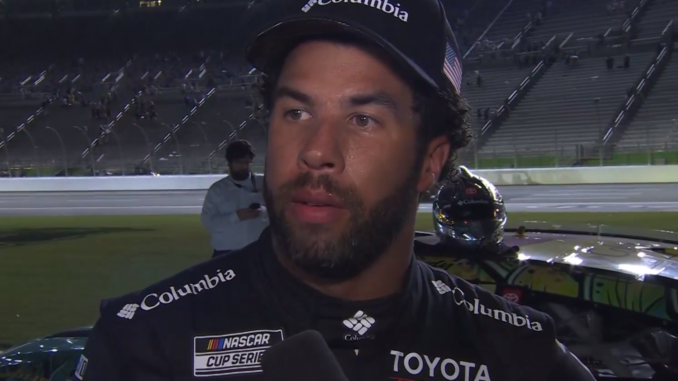
Sometimes the longest race of the night isn’t the one on the track.
For Bubba Wallace, the final 31 minutes of Sunday’s race at EchoPark Speedway (which actually happened early Monday morning) were spent inside NASCAR’s series hauler, trying to convince officials that what looked like a clear-cut violation wasn’t quite so simple.
It didn’t work.
Wallace crossed the finish line believing he had earned a runner-up finish behind Ryan Blaney after an overtime thriller stretched into the early hours of Monday morning. Instead, NASCAR ruled the driver of the No. 23 23XI Racing Toyota illegally advanced his position by driving below the double yellow line on the final lap, dropping him from second to 29th, the last car on the lead lap.
The penalty hinged on one question: Did Wallace gain a position below the yellow line?
Wallace insisted he did not.
“The rule says advancing your position, which I did not do,” Wallace told reporters after the penalty was announced. “I stayed third and I was all over the brakes to make sure I did not advance. As soon as I turned, I was like, ‘I am going to wreck.’ I got on the brakes, kept it underneath me and still ended up side-by-side.
“That move should have propelled us to the lead and it didn’t because I knew it was wrong because my car did not like that move. We’ll see what we can do, but I did not advance my position.”
On the white-flag lap, Wallace gave Blaney a push into the lead entering Turn 1 before diving to the inside down the backstretch. As Blaney and Carson Hocevar raced door-to-door, Wallace’s Toyota slipped beneath the yellow line while making it three-wide for the lead.
Wallace maintained he wasn’t trying to gain ground. Instead, he said he was trying to save an out-of-control race car.
“You go back and look at the SMT; I’m on the brakes trying to keep it underneath me and not advance my position,” Wallace said. “We’ve seen that in the past, all day, two cars get side by side into the corner, the guy that pops bottom clears. I didn’t clear, and that’s why we didn’t win the race, because I had to bail because I was going to crash.”
Wallace made the same case during his television interview moments after climbing from the car.
“I turned left and got super loose,” he said. “Just to keep it straight, I ended up there. It’s unfortunate. You can go back and look at SMT. I was all over the brakes trying to get the spot back. It says don’t go below the yellow line to gain your position, which I didn’t. I was still third, and I got a shove from the 54 to go to second. So technically, no positions were gained doing that.”
Instead of heading for the parking lot, Wallace headed for the data.
He first met with crew chief Charles Denike and 23XI Racing competition director Dave Rogers inside the team’s transporter, reviewing telemetry in hopes of building a case. Once satisfied they had their argument, the three walked together to the NASCAR hauler for a 31-minute meeting with series officials.
It was an unusual scene after one of the wildest superspeedway finishes of the season. Rather than arguing over interpretation from memory, Wallace wanted NASCAR to look at the electronic evidence, convinced the braking data would show he wasn’t attempting to improve his position.
NASCAR wasn’t persuaded.
Officials determined Wallace violated Section 8.7.2.A of the NASCAR Rule Book, which states, “Passing below the double painted lines to advance position will result in a black flag.”
After half an hour inside the hauler, Wallace emerged without the finish he thought he’d earned and without much left to say.
“A penalty is a penalty,” Wallace said as he walked away.
The penalty erased what had been one of Wallace’s strongest superspeedway performances of the season. He had rallied after earlier contact with Ty Gibbs, only to see the night’s biggest move become its most expensive one.
Wallace also acknowledged frustration with Gibbs after the race, saying the two Toyota teammates “don’t race very well together.”
But by the time he left the NASCAR hauler, there was no longer an argument to win.
The race was over.
So was the appeal.
“That’s Toyota teammates, we don’t race very well together.”
A tense finish for Bubba Wallace and Ty Gibbs at EchoPark @DanielleTrotta pic.twitter.com/UGy5gSsppT
— TNT Sports U.S. (@TNTSportsUS) July 13, 2026

Greg was a writer for DriveTribe supporting Amazon's The Grand Tour and has been published in major publications across the country including the Los Angeles Times, the Cleveland Plain Dealer and the Atlanta Journal-Constitution. He was also a contributor to Chicken Soup for the NASCAR Soul, published in 2010, and the Christmas edition in 2016. He wrote as the NASCAR, Formula 1, Auto Reviews and National Veterans Affairs Examiner for Examiner.com and has appeared on Fox News. He holds a BS degree in communications, and a Masters degree in psychology. He is currently the weekend Motorsports Editor for Autoweek and a regular contributor to Forbes.
- Hamlin’s nine-point Chase lead is becoming a very bad joke - September 13, 2026
- Kyle Larson outlasts flying cars, exploding brakes and Joey Logano in St. Louis - September 13, 2026
- Ryan Blaney’s championship charge takes a very hard right turn - September 13, 2026