
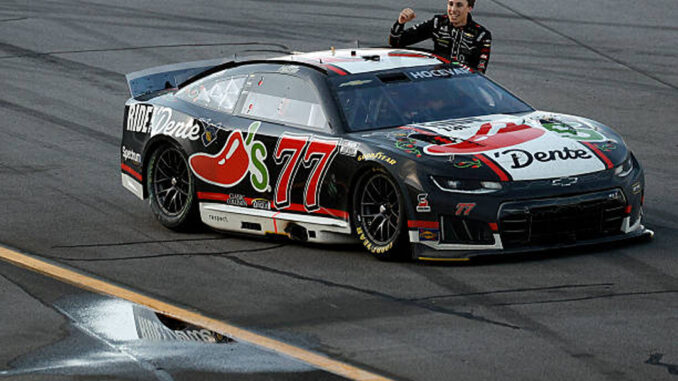
Hurricane season doesn’t officially start until June 1. However, there was a storm that raked across Alabama Sunday, specifically near the town of Talladega where a Category 5 named Carson Hocevar made landfall and refused to leave.
Hocevar, known as Hurricane Hocevar for his aggressive style of racing, scored his first career NASCAR Cup series win Sunday holding off Chris Buescher by .114 of a second in a race that officially finished under caution.
In reality, the 23-year-old Spire Motorsports driver didn’t win a race so much as outlast one. This was NASCAR’s version of Survivor, Talladega Edition only with more horsepower and fewer alliances that last longer than about half a lap.
Because earlier in the day, Talladega did what Talladega always does when it gets bored: it unleashed the Big One. Not just any Big One, mind you, this was a 26-car demolition derby that rewrote the definition of “multi-car incident.” Bubba Wallace was leading when the whole thing detonated in Turn 4, a chain reaction that behaved less like racing and more like a Newton’s Cradle at 200 mph. When the smoke cleared, the question wasn’t who was involved, it was who on earth wasn’t.
NASCAR red-flagged the race, partly to clean up the wreckage and partly, it seemed, to count the survivors.
That chaos, as always, reset everything. But even without half the field being turned into modern art, Hocevar’s arrival in Victory Lane felt inevitable. His driving style—equal parts bold, brash, and occasionally bordering on “what exactly was that?”—has drawn comparisons to the late Dale Earnhardt. And like Earnhardt, he has a knack for being exactly where he needs to be when it matters most.
Sunday, that moment came late.
After Tyler Reddick brushed the outside wall with 22 laps to go, the stage was set for a final duel. Buescher and Hocevar lined up at the front, each commanding a lane like rival generals waiting for the other to blink. The closing laps had that familiar Talladega tension—cars three-wide, inches apart, everyone fully aware this could end in either glory or a junkyard.
With seven laps to go, Hocevar made a move that raised eyebrows and probably a few heart rates, getting into Erik Jones and sending his Toyota spinning toward pit road. NASCAR kept the race green as Jones tried to gather it up—until he didn’t. Stuck in the grass on the frontstretch, the caution flew, and just like that, the chess match became a sprint.
Three laps to go. Green flag. No margin for error.
Hocevar and Buescher lined up exactly where they’d been before, like nothing had changed, except now everything had. When the white flag waved, Hocevar had a nose ahead. By the time they reached the tri-oval, it had grown into just enough of a gap to matter. Behind them, cars began to tumble again, because Talladega, and NASCAR threw the eighth and final caution of the day.
Race over. Storm complete.
Hocevar had done it.
“I posted on Instagram I didn’t really care, we were going to win, and we won, so…” Hocevar said afterward, sounding like a man who had already decided how the story would end long before the final lap. “I knew we were going to win. I really did.”
If that sounds like confidence bordering on madness, well, welcome to Talladega.
The celebration itself took nearly as long as the race’s final run. Hocevar climbed onto the driver’s side window and soaked it all as he rode his car slowly down the frontstretch.
“I don’t care if it took 20 minutes or whatever, I was going to figure it out how to do it,” he said. “This is the biggest dream I’ve ever thought of… Hopefully my grandpa’s watching. My grandma died last year, so I’m so thankful that I can give my grandpa a trophy now.”
For Buescher, it was the kind of near-miss that sticks with you.
“Man, obviously, yes,” he said when asked if he’d do anything differently, the kind of answer that says everything without saying much at all. “Felt like we were in a spot to take this Ford Mustang into victory lane… It was close.”
Close doesn’t quite cover it. This was Talladega-close, the sort of finish where you need a microscope and a strong cup of coffee to separate first from second.
Behind them, Alex Bowman put together a quietly impressive third-place finish just weeks after dealing with vertigo symptoms, followed by Chase Elliott and Zane Smith. Ricky Stenhouse Jr., Ross Chastain, Austin Cindric, Noah Gragson, and Kyle Busch rounded out the top ten, though simply making it that far felt like an achievement in itself.
NASCAR’s tweak to the stage lengths, shortening the final two to eliminate fuel-saving games, worked exactly as intended. Stage 1 lulled everyone into a false sense of security. Stage 2 lit the fuse. By the end, it was pure Talladega: unpredictable, occasionally absurd, and utterly compelling.
Next stop is Texas Motor Speedway, where everything is supposedly bigger.
But after Sunday, that might need a revision. Because in NASCAR right now, nothing is bigger, or more unpredictable, than a storm named Hocevar.
RACE RESULTS

Greg was a writer for DriveTribe supporting Amazon's The Grand Tour and has been published in major publications across the country including the Los Angeles Times, the Cleveland Plain Dealer and the Atlanta Journal-Constitution. He was also a contributor to Chicken Soup for the NASCAR Soul, published in 2010, and the Christmas edition in 2016. He wrote as the NASCAR, Formula 1, Auto Reviews and National Veterans Affairs Examiner for Examiner.com and has appeared on Fox News. He holds a BS degree in communications, and a Masters degree in psychology. He is currently the weekend Motorsports Editor for Autoweek and a regular contributor to Forbes.
- Kyle Busch’s legacy gets a smoky exclamation point in Charlotte - October 10, 2026
- Photos: Kyle Busch Celebration of Life at Charlotte Motor Speedway Friday Oct. 9, 2026 - October 10, 2026
- Layne Riggs gives Honeycutt a Charlotte-sized championship headache - October 9, 2026