
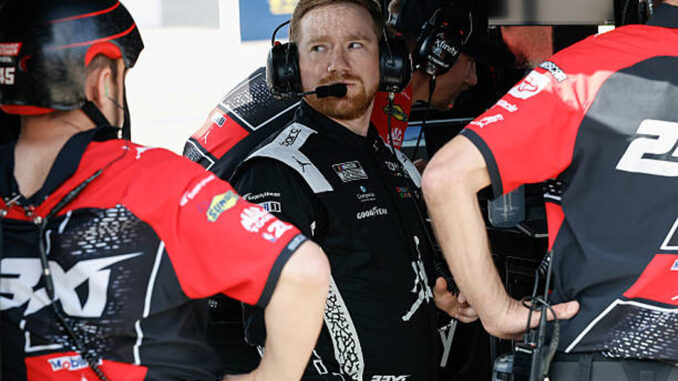
Tyler Reddick climbed from the No. 45 Toyota at Darlington Raceway, his fire suit still soaked through — not from champagne, but from a race he spent managing a blown cool suit with a literal bag of ice stuffed against his chest. His alternator failed on Lap 1. His cool suit failed soon after. Brad Keselowski led with comfortable authority through two full stages. By any rational measure, Reddick’s afternoon should have been a damage-limitation exercise.
Instead, he hunted Keselowski down over the final 50 laps and crossed the line 5.847 seconds clear. Four wins in six races. The first driver in NASCAR Cup Series history to win the opening three races of a season. Only the third driver in the sport’s entire history to win four of his first six — joining Dale Earnhardt in 1987 and Bill Elliott in 1992. Perhaps even more importantly, neither Earnhardt nor Elliott won the championship in those years.
Tyler Reddick’s Championship Challenge
Online betting sites feel that 2026 could well be different. The latest sports betting odds at Bovada currently list Reddick as a narrow +600 second-favorite, with only reigning champion Kyle Larson considered more likely at +550. And here’s exactly why they think that the narrative could change: it’s not just the wins, it’s the variety of the early championship leaders’ wins, and the manner of them.
He won the Daytona 500 — the race that the sport orbits around, the one that announces a season’s narrative before a single superspeedway lap has been turned elsewhere. Then, Atlanta, where he mastered a two-mile drafting chess match with the timing of a driver who’s been dialed in since January testing. Then COTA, from pole position, on a road course that should theoretically level the playing field, where he obliterated the chasing pack on a circuit that rewards the complete package — car, setup, driver feel.
Beautiful day for racing https://t.co/jj7Pv4xUko
— Bovada (@BovadaOfficial) February 15, 2026
Then Darlington, turning equipment failure and a bag of ice into mythology. A 95-point cushion over Ryan Blaney in the standings, and the sense — rare in NASCAR, genuinely rare — that we might be watching something unrepeatable. Could anyone stop him?
So, what are the best starts to a NASCAR season in recent memory? And, crucially for Reddick’s case, did any of them culminate in the championship? Let’s take a look.
Christopher Bell — 2025
Christopher Bell looked every inch a champion-in-waiting through the first month of 2025. Three consecutive wins — Atlanta’s banking, COTA’s chicanes, Phoenix’s mile oval — three different configurations, three different demands on both driver and machine. Bell was answering every question the sport could throw at him. Was this finally his year? The NASCAR world had already started writing the coronation piece.
Then came 24 races of silence. Not bad silence — Bell still ran respectably, still accumulated points, still looked like a playoff contender. But the urgency evaporated. The electricity of those first three races, the sense that he had everyone figured out? Gone.
When you’ve burned that bright that early, the dimming registers twice as hard. He won at Bristol in the playoffs to stay alive, but Larson was lurking, knowing full well that championships are won in October, not February. Bell finished fifth in the standings. Four wins, 13 top-fives, 22 top-10s — numbers most drivers would trade their crew chief for — and yet he never sniffed the Championship 4. Larson stole his crown not because he was more dominant, but because he peaked at the right time.
The early-season fireworks? Beautiful, and ultimately irrelevant. That’s Bell’s 2025 in one sentence.
Kevin Harvick — 2018
Numbers alone don’t capture the specific cruelty of Kevin Harvick’s 2018 season. Atlanta. Las Vegas. Phoenix. Three straight wins in Races 2, 3, and 4. Then New Hampshire. Then Michigan. Then Dover. Then Kansas. Eight wins through 26 regular-season races in a Stewart-Haas No. 4 Ford that was the most dominant car in the Cup Series. On pure merit, measured over 26 races, Harvick won the 2018 NASCAR championship with room to spare. Except the season is 36 races long, not 26.
Joey Logano — who had managed four wins through the regular season and looked like a solid but unremarkable contender — danced at Homestead-Miami while Harvick watched from an early playoff exit. The format worked exactly as designed: it took everything Harvick had built across 26 weekends, hit the reset button in September, and handed Logano a blank slate and a clean run to the title.
What does it mean when the most dominant car in the garage goes home without a trophy? In any other major sport, it means a scandal. In NASCAR, it means Tuesday. The playoff format is a deliberate act of competitive engineering, and Harvick paid its most brutal price. Eight wins. Zero championships. An injustice preserved in the record books forever.
Jimmie Johnson — 2010
Jimmie Johnson came into 2010 as a four-time defending champion, which meant the bar for “impressive” had been relocated to the outer atmosphere. Fontana in Race 2. Las Vegas in Race 3. A slight dip at Atlanta, then straight back to victory lane at Bristol in Race 5. Six wins total. Seventeen top-fives. Twenty-three top-10s. Denny Hamlin pushed him all the way to Homestead, and Johnson responded with a second-place finish to seal the fifth consecutive championship that no driver before or since has matched.
Make no mistake about what Johnson did between 2006 and 2010. Five consecutive titles in a format specifically designed to make that impossible. He didn’t just peak at the right moment; he simply never stopped peaking.
